

He’s Not Really Choosing His Phone Over You — Here’s What to Say
Let me tell you about Tuesday night at my house. Pasta going cold. My husband across the table, watching a man pressure-wash a driveway. Not laughing. Not even smiling. Just scrolling. Blue light on his face like a tiny moon.
I’d told him about the thing with my boss. Got a “mm-hm.” Eyes never left the screen.
And suddenly I’m not hungry anymore.
Here’s the part I can’t shake, though. Three feet away. The person I chose — who chose me — and I’ve never felt further from him.
If your dinner table looks like that lately — welcome. You’re not the only one who’s typed “husband always on his phone” into Google at 11 p.m., hoping somebody out there actually gets it. This isn’t a lecture, and I’m not here to fix your husband. I just want to talk about why it stings so much, why yelling about it never works, and the actual words that might.

Why It Hurts More Than It Should (It’s Not Really About the Phone)
Here’s the thing nobody says out loud: it’s not the phone. It’s what your brain does with the phone.
He’s scrolling. Your brain translates: “I’m boring. He’s bored of me.” A $900 rectangle just told you you’re not interesting enough to look at. No wonder dinner’s ruined.
Then there’s the restaurant version. Couple next to you, laughing their heads off. Your guy hunched over, thumb going like a metronome under the table. You’re embarrassed. Then embarrassed about being embarrassed. Then mad at him, the waiter, and the entire concept of Wi-Fi.
That spiral? It’s not about a phone. It’s about missing him.
Remember when you were dating? You’d sit in some booth until the staff started stacking chairs, talking about nothing, and it felt like the most important conversation in the world. He hung on every word. You hung on his. Nobody’s asking to time-travel. You just want a little of that back — someone across the table who actually wants to hear about your day.
Somewhere between the mortgage and the laundry and seventeen group chats, you lost your audience of one. Of course that hurts.
Why Nagging and Criticism Only Make It Worse
So what do we do? We snap.
“You’re ALWAYS on that stupid phone!”
He looks up. Annoyed. You feel guilty. Nothing changes — except now dinner comes with tension on the side.
Here’s the ugly truth: criticism makes a man defensive. And a defensive man doesn’t put the phone down. He grips it tighter. You attack, he withdraws — and for a lot of guys, withdrawing looks exactly like scrolling. You’re not getting through to him. You’re handing him another reason to check out.
That doesn’t mean you swallow it and smile. It means how you say it matters as much as what you say. The phrases that blow up in your face — and what works instead:
- “You’re always on that stupid phone.” → “I feel lonely at the table when we’re both on our screens.”
- “You care more about your phone than me.” → “I miss talking to you at dinner. I miss us.”
- “Put that down right now.” → “Can we try twenty phone-free minutes tonight?”
- “You never listen to me.” → “I told you about my day earlier and I don’t think you heard me. That one mattered.”
- “It’s me or the phone.” → “I’d love a little more us-time at dinner. Can we figure it out together?”
See it? The first batch is all about him and what he’s doing wrong. The second batch is about you and what you need. Tiny shift. Completely different conversation.
What to Say the First Time You Bring It Up
Timing. This is everything.
Do not — I repeat, do not — bring it up mid-scroll while the food’s dying and your blood’s boiling. Wait for a calm moment. Morning coffee. A lazy Sunday. A walk around the block. You want his brain in listening mode, not defense mode.
Then keep it short. Specific. Warm. Steal this word for word:
“Hey, can I tell you something that’s been on my mind? It’s not a big deal, but the last few dinners I’ve felt kind of lonely at the table. I miss talking to you. Could we try keeping phones away during dinner? Even just twenty minutes?”
No lecture. No list of every offense since March. One feeling, one small ask. And notice the ask: “twenty minutes at dinner” is something a human can actually do. “Be more present” is not.
Want the blunter version? Here:
“I need to say this before it gets bigger in my head. When you’re on your phone at dinner, I feel invisible. I don’t think you mean it that way. But that’s how it lands. Can we make dinner a no-phone zone?”
Both end with a question, not a demand. A question makes him your partner in the fix. A demand makes him the defendant.
When He Gets Defensive: What to Say Next
Okay, real talk: he might get defensive anyway. The greatest hits: “I’m working.” “I barely looked at it.” “Nothing I do is good enough.”
Do not take the bait. The second you start debating how many minutes he was on the phone, you’ve lost. Now you’re his opponent. And opponents don’t get eye contact either.
Instead: agree a little, shrink the ask, then stop talking. “You’re right, I’m not saying you never pay attention. I’m just talking about dinner.” Then let the silence sit there. Silence is uncomfortable. That’s the point.
Your script for the defensive moment:
“Okay, I hear you — I know work’s been insane, and I’m not saying you’re a bad husband. I’m asking for one small thing: dinner. Can we just try it?”
If he says “fine” through gritted teeth? Take it. A grumpy yes still counts. The habit matters more than the enthusiasm. Enthusiasm usually shows up later, once he remembers what talking at dinner actually feels like.
And if work is genuinely the reason? Try this: “What if on the nights you’re on call, you tell me at the start of dinner — and the other nights, phones go away?” That’s a compromise, not a surrender. It also quietly answers whether “work” is the real reason or the convenient one.
When He Agrees — Then Relapses Three Days Later
Nobody warns you about this part. He says yes. Monday’s lovely. Tuesday’s lovely. Wednesday he’s on the couch at 7:14, thumb going, and your heart drops into your shoes.
Do not say “THREE DAYS. That’s how long it lasted.” I know you want to. Don’t.
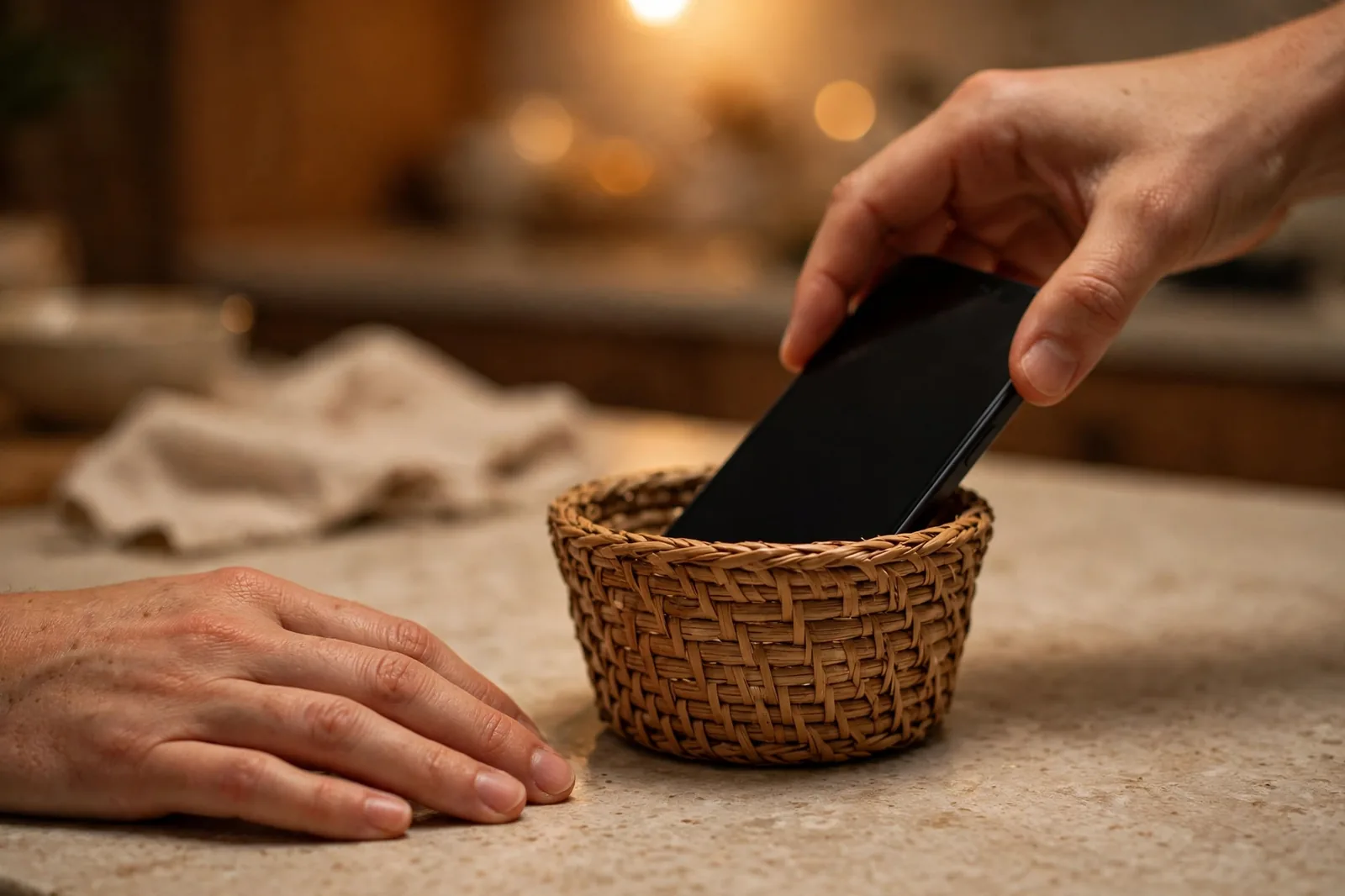
A relapse isn’t proof he doesn’t care. Habits are sticky. That phone has been his default setting for years — three good dinners don’t rewire a brain. Keep it light: “Hey — phone basket?” Smile when you say it. Make it a game you’re both playing, not a test he’s failing.
But if it keeps happening — a pattern, not a slip — you get one calm follow-up. One. Not five:
“I’ve noticed we’ve slipped back into phones at dinner. Is the rule not working, or is something else going on? I want to figure it out with you.”
That last sentence does a lot of quiet work. It says you’re curious, not furious. And sometimes the phone isn’t the problem at all. It’s the escape hatch.
The Phone Basket Rule: A Ritual That Actually Works
Forget willpower. Willpower loses to notifications every single time.
What works is a ritual. Something physical. Something you both do. Something a little bit fun.
Get a basket. A bowl. A drawer, I don’t care. The rule: when dinner hits the table, both phones go in. Both. Not just his — that’s a punishment. Both of yours — that’s a pact. They stay until the dishes are cleared. Twenty, thirty minutes. Nobody’s going off-grid. It’s one meal.
Why does a basket work when asking nicely doesn’t? Because it’s not emotional anymore, it’s environmental. It kills forty tiny nightly decisions — “should I check that?” — and replaces them with one decision you already made together.
Start small on purpose. Just dinner. Just weeknights, if weekends feel impossible. Easy wins build momentum. Let them.
Try the 2-Week Experiment (Instead of a Forever Fight)

Don’t make it a forever rule. Make it a two-week experiment. Say it exactly like that: “Let’s try it for two weeks. If it’s miserable, we drop it.”
Nobody’s scared of a trial. “No phones at dinner forever” sounds like a life sentence. “Two weeks” sounds like a game.
Then review it together. Sunday, coffee: “So. The basket thing. Keep it or kill it?” Most couples keep it. By week two the conversations got better. Dinner got longer. Somebody told a story they’d been saving without knowing it.
And if he votes to kill it? Good — now you have real information. Ask, gently, what felt bad about it. That’s a way more useful conversation than another fight about screen time. The experiment turns a power struggle into data. And data is a lot easier to talk about than disappointment.
Is It a Demanding Job — or Emotional Avoidance?

Sometimes “I’m working” is true. Sometimes it’s a shield. Here’s how you tell.
Probably the job if: he’s stressed, not relaxed. He apologizes before you even bring it up. Phone goes away on weekends and vacations. The scrolling clusters around real deadlines and fades after. He still reaches for you — asks about your day, notices when you’re off.
Probably avoidance if: the phone’s out during every conversation, not just dinner. He grabs it when things get tense or quiet. He looks relieved when a text interrupts a real moment. Short answers. Changed subjects. Jokes that dodge. The phone’s the symptom; the distance is the disease.
Job? The basket rule plus some grace will handle it. Protect the dinners you can. Give him slack on the ones you can’t.
Avoidance? Then the phone talk is just the first talk. Be kind to yourself here — people check out when they’re overwhelmed or quietly unhappy about something they haven’t named yet. “Is something else going on?” is your way in. And if the door stays shut, that’s what couples counseling is for. Not a threat. A tune-up. The strongest couples I know went before things broke.
You started all this because you noticed you felt lonely at your own table. That noticing? That was the brave part. Everything after is just follow-through.
You don’t need him to be perfect. You just need him at the table, eyes up, twenty minutes a night. You need the person who once stayed up till 2 a.m. talking to you in a parked car to look up from his phone and remember you’re still the most interesting thing in the room.
That’s not too much to ask. It never was.
Keep Reading
If this hit home, these might too:
3 Comments