The Fridge Calendar That Keeps Couples in Sync
Phone calendars fail because only one person sees them. One paper calendar on the fridge, both of you writing on it, and a Sunday glance keep a couple in step.

The Fridge Calendar That Keeps Couples in Sync
We missed a dinner with friends last October because of a calendar. Not a big calendar problem, not a lost phone or a dead battery, just the ordinary kind. My husband had put the dinner on his phone calendar, and I had put a work event on mine, and neither of us looked at the other’s phone that week, because why would we. We found out about the clash at six o’clock on the night of the dinner, when he was putting on his shoes and I was already in the car going the other way. We apologized to our friends, we ate leftovers, and we sat at the kitchen table and said the sentence that changed how we run our week. “We need one calendar, and we both need to see it.”
That calendar lives on our fridge now. It is a paper calendar, the kind with big squares, held up by two magnets shaped like lemons, and it is the single most useful thing in our kitchen. It is not fancy. It does not sync, it does not remind, and it cannot do anything a phone cannot do better, except for one thing. Both of us see it, every day, without trying.
Why phone calendars fail

Phone calendars fail for couples for a reason that has nothing to do with technology. They fail because they are private. Your phone calendar is yours. It sits in your pocket, it shows your events, and it only speaks to you. Your spouse’s phone calendar is theirs, and it only speaks to them. Two private calendars can hold the same information and still leave a couple out of step, because neither person ever sees the other’s week.
The second problem is that phone calendars hide what matters. A phone shows you today, and maybe tomorrow, and the rest of the week sits behind a swipe you have to remember to make. A paper calendar on the fridge shows you the whole month at a glance, every time you reach for the milk. You do not have to remember to check it. You cannot avoid it. It is there when you make coffee, when you pack a lunch, when you come home tired and open the fridge looking for something to eat. That is when you need to see the week, and that is when the fridge calendar shows it to you.
The third problem is that phone calendars have one owner, even when they are shared. Someone set up the shared calendar. Someone sends the invites. Someone fixes it when it breaks. In most houses, that someone is one person, and the other person is a guest in a system they did not build. A paper calendar has no owner. It hangs on the fridge, both of you can write on it, and neither of you has to ask the other for permission to add a dentist appointment.
We kept our phone calendars, because they are good at reminders, and a reminder at nine in the morning is still useful. But the phone is the backup now, and the fridge is the plan. If it is not on the fridge, it is not real, and that one rule has saved us more missed dinners than any app ever did.
A shared journal works the same way in words. It sits where both of you can see it, and it holds what you both need to know, in a place neither of you has to go looking for. The fridge calendar does it in squares and ink, and it works just as well.
The fridge calendar setup
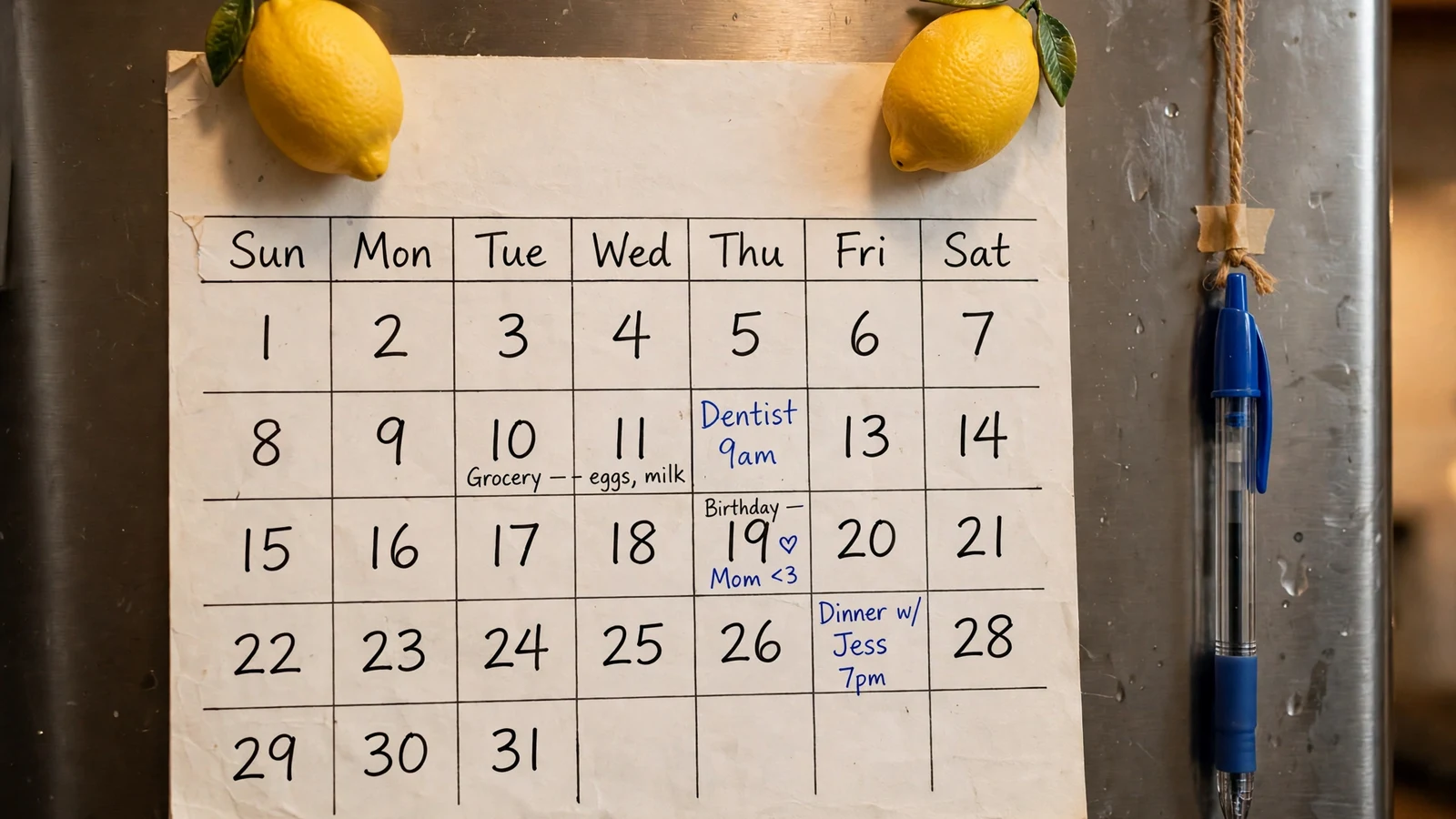
The setup is simple, and the simple version is the one that survives. One calendar, on the fridge, big enough to write in, and two pens attached to it so neither of you has an excuse not to write. Ours is a wall calendar with squares about two inches wide, which is enough room for a short note and a time. We hang it at eye level, on the front of the fridge, not the side, because the side is where things go to be forgotten. Two magnets hold it up, and a pen hangs from a string on the handle, because a pen that lives in a drawer is a pen that never gets used.
We use two pen colors, and that is the whole system. Blue is his, black is mine, and anything we both need to know gets written in red. A blue square that says “Dinner with Tom and Ana, 7pm” is his plan, and I can see it. A black square that says “Dentist, 9:30” is mine, and he can see it. A red square that says “Anniversary dinner, book table” is ours, and we both see it, and we both know it needs doing. The colors are not a rule anyone enforces. They are a habit, and habits are what make a shared calendar work.
Every event goes on the calendar the day you learn about it, not the day before it happens. That is the one rule we do not break, and it is the rule that makes the whole thing work. A dinner invitation gets written down the night it arrives. A work trip gets written down the day the dates are confirmed. A school event gets written down the moment the flyer comes home. The calendar only works if it is current, and it is only current if writing on it is faster than forgetting about it. A pen on a string is faster than an app with a password.
We also keep a small box at the bottom of the calendar for the things that do not fit in a square. The plumber’s number, the name of the friend who owes us a book, the date the car needs its oil changed. It is not pretty, and it is not organized, but it is all in one place, and one place is the whole point. A morning coffee ritual is the time we check it, because the coffee is already brewing and the fridge is already right there, and the calendar is already in front of us.
The Sunday glance

The Sunday glance is the habit that holds the calendar together, and it takes about five minutes. Every Sunday evening, after dinner, we stand at the fridge together and look at the week ahead. Not a meeting, not a planning session, just a glance, the two of us, coffee in hand, reading the squares out loud.
We start with Monday and walk across the week, square by square, and we say what we see. “You have the dentist on Tuesday.” “We have dinner with your parents on Thursday.” “Friday is empty, do you want to do something?” That is the whole conversation, most weeks. It is short, it is ordinary, and it is the reason we have not missed a dinner since October. A week you have both seen is a week you can both plan around. A week only one of you has seen is a week full of surprises, and surprises are rarely the good kind.
The glance also catches the clashes while there is still time to fix them. Two events on the same night, a work trip that overlaps a family visit, a school pickup that lands on the same afternoon as a doctor’s appointment. When we spot a clash on Sunday, we have five days to sort it out. When we spot a clash on the night itself, we have nothing but an apology. The Sunday glance is not about planning. It is about catching the problem early, when it is still small.
It also catches the empty spaces, and the empty spaces matter as much as the full ones. A blank Friday square is a chance to do something together, and a blank Saturday is a chance to rest, and a week with no empty squares at all is a warning. When we see a week that is full, we talk about what can move, and what can wait, and what we are doing to ourselves. The calendar shows us our life, and sometimes our life needs editing, and the Sunday glance is when we do it.
A weekly check-in together covers the same ground in a different way, and the two habits fit together well. The check-in is the conversation. The Sunday glance is the calendar that makes the conversation easy. Do the glance first, and the check-in has something real to talk about.
If your week keeps surprising you, try this. Buy a paper calendar, hang it on the fridge, tie a pen to the handle, and stand in front of it together every Sunday for five minutes. It will feel old-fashioned for a week, and then it will feel like the most normal thing in your kitchen, and then one day you will wonder how you ever ran a marriage without it.
Tell me, what is the one event your household keeps missing, and where does it live right now, on your phone or on the fridge?
Exact words to say

A shared calendar needs a few sentences, because it can feel like a chore, and the right words make it feel like a shared project instead.
To propose it, try this. “We missed that dinner because our calendars live on two different phones. What if we put one paper calendar on the fridge and both of us write on it?” That sentence names the problem, names the fix, and makes it something you do together.
When you add an event, say it out loud. “I just put your mom’s birthday dinner on the fridge for Thursday, seven o’clock.” That sentence tells your spouse what you wrote, and it gives them a chance to catch a clash right away, while you are both standing there.
When you spot a clash on Sunday, name it plainly. “We have two things on Friday night, and we can only do one. Which one matters more to you?” That sentence treats the clash as a shared problem, not as someone’s mistake, and it asks for a choice instead of an argument.
When the week goes well, say so. “We did not miss anything this week, and I think the calendar is why.” That sentence gives the calendar credit, and it reminds both of you that a small habit is doing real work for your marriage.
A calendar that works is a calendar you both use, and a review of the month together is a good time to check whether yours is working. Ours takes five minutes on the first Sunday of the month. What did we miss, what did we catch, and is the calendar still on the fridge, or has it slid behind the cereal boxes again.
Frequently asked questions
Do couples really need a paper calendar if they have phone calendars?
Yes, if the phone calendars keep missing each other. A paper calendar on the fridge works because both of you see it every day without trying, and because writing on it takes two seconds with a pen that hangs right there. Keep the phone for reminders, and let the fridge be the plan both of you can see.
What should go on a couples fridge calendar?
Everything that affects both of you, or that one of you needs the other to know. Dinners, appointments, work trips, school events, family visits, and the nights you have kept free on purpose. If it changes when someone needs to be home, it belongs on the fridge.
How do couples keep a shared calendar up to date?
Write on it the day you learn about an event, not the day before it happens, and stand in front of it together every Sunday for five minutes to look at the week ahead. The daily habit keeps it current, and the Sunday glance catches the clashes while there is still time to fix them.
Keep Reading
If this hit home, these might too:
- Couples Shared Journal
- Morning Coffee Ritual for Couples
- Weekly Marriage Check-In
- Couples Review the Month Together
Going through something similar?
Share your experience anonymously with the Ever After Daily community. Every story is read by a human editor before anything is published.
Share Your Story