Couples Who Travel as Two Again After Years of Family Trips
After years of family trips, the first trip as just two feels strange. How one couple picked a short, close trip and learned to travel together again.

Couples Who Travel as Two Again After Years of Family Trips
For twenty years, every trip we took had a back seat full of people. There were snacks to hand back, fights to referee, a bathroom stop every forty minutes, and a schedule built around nap times and bedtimes and somebody’s practice the day we got home. We loved those trips. We also forgot, somewhere along the way, how to take a trip with just the two of us in the car.
So we booked one. Three nights, two hours from home, one small town with a main street and a bakery and a bed and breakfast that had a porch. It was the first trip we had taken as just two people since before the kids were born, and it felt strange in a way we had not expected. Nobody needed us to drive. Nobody asked what was for dinner. The car was quiet, and the quiet followed us into the hotel room, and we sat on the edge of the bed for a full minute, looking at each other, wondering what married people do on a trip when there is nobody to chase.
If that sounds familiar, you are not bad at traveling. You are just out of practice. A couple that only ever traveled as a family has to learn the trip again, the way they had to learn the first quiet week at home all over again when the kids left.
Why the first trip as two feels strange

The strangeness starts before you leave. You pack a bag and it is too small. You keep reaching for the things you always packed, the extra snacks, the first-aid kit, the charger with four ends, and then you stop yourself, because there is nobody in the back seat to need them. The bag feels light in a way that feels wrong. You check it twice. You check it a third time.
Then you get in the car, and there is nobody to hand a juice box to, and nobody asking “Are we there yet?” from behind your right ear, and the radio plays a whole song without anyone talking over it. You reach for the volume and then you stop, because the quiet is the point, and the quiet is also the problem. For years, the kids filled every silence in the car. Without them, you have to fill it yourselves, and two people who spent twenty years talking about schedules and permission slips have to remember what else they talk about.
The strangeness follows you into the town. You walk down the main street and there is nobody pulling you toward the toy store, nobody who needs to stop, nobody who is hungry right now. You can go into any shop you want. You can sit on any bench for as long as you want. That sounds like freedom, and it is, but it also feels like standing in a grocery store with no list. You keep looking around for the person who tells you what to do next, and the only person there is your spouse, looking back at you with the same lost expression.
Here is the part nobody warns you about. The first trip as two can bring a fight. Ours came on the second morning, over breakfast, over nothing. He wanted to walk to the lighthouse. She wanted to sit on the porch with coffee. Both of them were right, and both of them were tired, and the fight was not about the lighthouse. It was about two people who had not had to agree on a plan with just each other in a very long time. If one of you goes quiet in the middle of that kind of morning, it usually means the trip needs a slower hour, not a bigger talk. The same patience that helps when a husband goes quiet and needs space helps here too: give the quiet an hour, then try the plan again.
Picking the first trip

The first trip should be short, close, and built around one thing to see. Short, because three nights is long enough to learn the rhythm and short enough that a bad day does not ruin the whole trip. Close, because a two-hour drive means you can go home if you need to, and knowing you can go home makes it easier to stay. One thing to see, because a list of ten sights turns a trip for two back into a family trip with the family missing.
We picked a town with a lighthouse, because there was a lighthouse and a bakery and a porch, and that was the whole plan. We drove up on a Friday, checked in, walked to the bakery, and ate the pie on a bench. That was the first day. It was enough. On Saturday we walked to the lighthouse, slowly, stopping at every shop that looked interesting, and we sat on the rocks for an hour and watched the water. That was the second day. On Sunday we drove home, and the drive took two hours, and we talked the whole way, about the pie and the rocks and the bed and breakfast and the people at the next table, and the car did not feel quiet at all.
Pick the trip the same way you would pick a first date: small, close, and easy to leave if it goes badly. A town you can drive to. A place with one good restaurant and one good walk. A hotel with a porch or a bench or a window worth sitting beside. Leave the big trip, the one with the flights and the passports and the week of planning, for the second or third time out. The first trip is a practice trip, and practice trips should be kind.
There is one more rule for picking it. Pick it together, out loud, at the kitchen table, the way you used to pick a family trip, with one of you holding the map and the other one holding the coffee. If one of you picks it alone, the other one spends the whole drive wondering whether they were supposed to want it. Say the town out loud. Say what you will do there. Say what you will not do there. Then book it, and do not spend the week before the trip reading reviews until the trip turns into homework.
The trip that taught them to travel together again
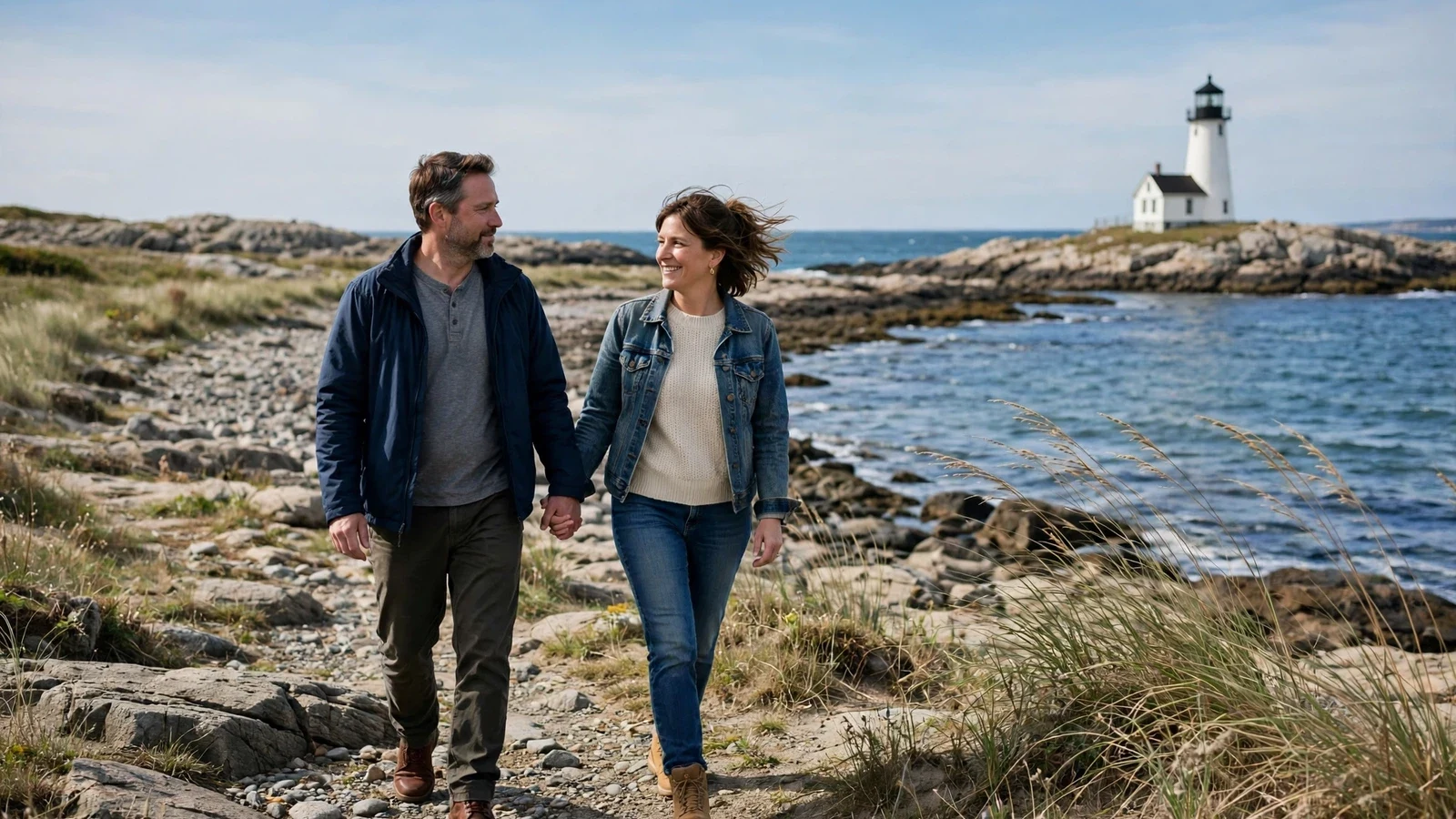

The trip that taught us was not the lighthouse trip. It was the second one, six months later, to a town three hours away with a lake and a farmers market and a motel with a pool nobody used. By then we knew a few things. We knew to pack light and to bring one book each. We knew to eat breakfast late and to walk after dinner, the way a slow walk after dinner turns an ordinary evening into something worth remembering. We knew that the best part of the day would be the hour with nothing planned in it.
On that trip, we learned the rhythm that has held ever since. Mornings are slow. Coffee first, then a walk, then breakfast wherever looks good. Afternoons are for the one thing we came to see, and if the one thing takes twenty minutes, the rest of the afternoon is for sitting somewhere and watching the town go by. Evenings are for dinner and the walk after, and the talk that only happens on a walk, when you are facing the same direction instead of sitting across a table from each other.
We also learned to take turns choosing. One day is his, one day is hers, and the person whose day it is picks the restaurant and the walk and the thing to see, and the other person goes along without a review of the plan. It sounds small, and it is, but it ends the quiet argument about whose turn it is to be happy on a trip. A weekly check-in works the same way at home: a short, regular time to say what you want, before the want turns into a grudge.
The trip that taught us also taught us this: traveling as two is not the family trip with the kids removed. It is a different trip entirely. The family trip was about keeping everyone fed and happy and on schedule. The trip as two is about going slow enough to notice each other again. The lighthouse was fine. The pie was good. The best part was the hour on the rocks with nothing to do and nobody to chase, and the talk that came out of that hour, the kind of talk you cannot have in a car full of people asking for snacks.
Frequently asked questions
How short should the first trip as two be?
Two or three nights is right for most couples. One night is too short to settle into the rhythm, and a week is long enough for a bad morning to feel like a failed trip. Three nights gives you one day to arrive, one full day to enjoy, and one morning to pack up slowly, and that is enough to learn what you like.
What if my spouse wants a big trip and I want a small one?
Then take the small one first. A short, close trip is a test, not a verdict. If it goes well, the big trip gets easier to plan, because you will both know what a good day on the road looks like for the two of you. If the small one goes badly, you have lost a weekend, not a week and a plane ticket.
What if we run out of things to talk about?
You will not, once the trip slows down. The quiet in the car on the first morning feels strange because you are used to noise, not because you have nothing to say. Give it a day. Talk about the town, the food, the people at the next table, the house you pass on the walk. The bigger talk comes on its own, usually on the second evening, usually on a walk.
What was your first trip as just two, and where did you go? Tell us in the comments, if you are willing. Your answer might help another couple pick their town.
Going through something similar?
Share your experience anonymously with the Ever After Daily community. Every story is read by a human editor before anything is published.
Share Your Story