Why Your Marriage Feels Different After Having a Baby
Your marriage feels different after a baby — busier, quieter, more like roommates. Here’s what actually changes, why it feels so jarring, and what helps most.

You bring the baby home, you set the car seat down in the living room, and for about ninety seconds everything feels exactly like the movie version. Then somebody needs a clean onesie, somebody else needs to eat standing up over the sink, and you realize you haven’t looked at your spouse in six hours.
That’s usually when it hits. Not all at once. Slowly. Your marriage feels different after having a baby, and not just in the obvious “we’re tired” way. It feels structurally different, the way a house feels after you’ve knocked out a wall. Same address. Totally different layout.
If you’re sitting in that right now, wondering why the person you chose feels a little far away even when they’re right there on the couch next to you, you’re not broken and you’re not behind. You’re in one of the biggest identity shifts two people can go through together. Here’s what’s actually going on under the surface.
What Actually Changes After a Baby

People say “everything changes” like it’s a warning label. It’s not wrong, but it’s so vague it doesn’t help. What changes is more specific than that, and naming it makes it less scary.
Your time is no longer yours to trade. Before the baby, you could be spontaneous. A late dinner, a lazy Saturday, a conversation that wandered until midnight. After the baby, time comes in small, interrupted pieces. A twenty minute stretch of quiet feels like a vacation. That changes how available you are to each other, because even in the same room, part of your brain is listening for the monitor, the cry, the timer on the bottle warmer.
Talk becomes almost entirely practical. When did she last eat? Who’s doing the next diaper? Did we order more wipes? None of that is bad. It’s necessary, and it’s how a house keeps running. But when practical talk is the only talk you have, you start to feel like coworkers running a very small, very loud company. The personal stuff — what scared you today, what made you laugh — gets pushed to a later that almost never shows up on its own.
Touch changes shape. The affection that used to be casual — a hand on the back while passing in the kitchen — suddenly has to compete with a baby who is literally on your body for hours at a time. A lot of new parents describe feeling “touched out” by evening, and that’s not rejection. That’s a nervous system that has been needed, physically, all day long. The other partner often doesn’t hear it that way at first, which is where distance creeps in.
Sleep stops being background and becomes the main character. You don’t just feel tired. You feel less patient, less funny, less generous with the benefit of the doubt. A comment that would have rolled off you in June lands differently at 3 a.m. in October when you’ve been up four times. Exhaustion doesn’t create problems out of nothing, but it turns the volume up on every small one.
None of this means love went anywhere. It means the conditions love used to travel through — time, energy, attention — all got rerouted at once.
Why Nobody Warns You It Feels This Different
It’s not that people are keeping a secret. It’s that the real changes are hard to describe without sounding ungrateful, and new parents learn fast that “we’re struggling a little” can get heard as “we don’t love this baby enough.” So most people just say they’re tired and move on.
There’s also a split in how the story gets told. During pregnancy, all the attention goes to the baby and the birth. Very few people ask the question that matters three months later: how are the two of you doing as a couple in all of this?
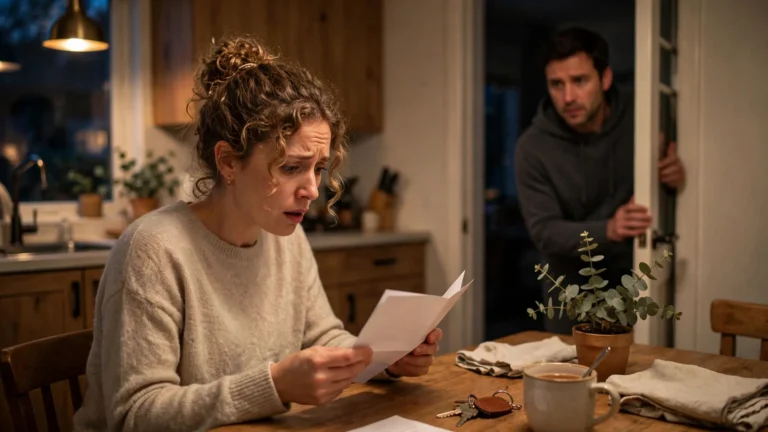
And honestly, some of it you can’t understand until you’re in it. You can be told you’ll be tired. You cannot be told what it does to you to hear your own baby cry in the next room while you’re trying to hold a normal conversation about your day. You can be told dates will be harder to plan. You cannot be told how lonely it can feel to sit on separate ends of the same couch, both scrolling, both too wrung out to start the conversation you both actually want to have.
If it helps, most couples who look “fine” from the outside are dealing with some version of this. The friend who posts the cute pajama photo also had a week where they mostly communicated in notes on the fridge.
The Roommate Trap Nobody Expects

This is the one that catches good couples off guard. You don’t fight more, exactly. You don’t stop caring. You just slowly slide into a setup where you’re an excellent team and a strangely distant couple.
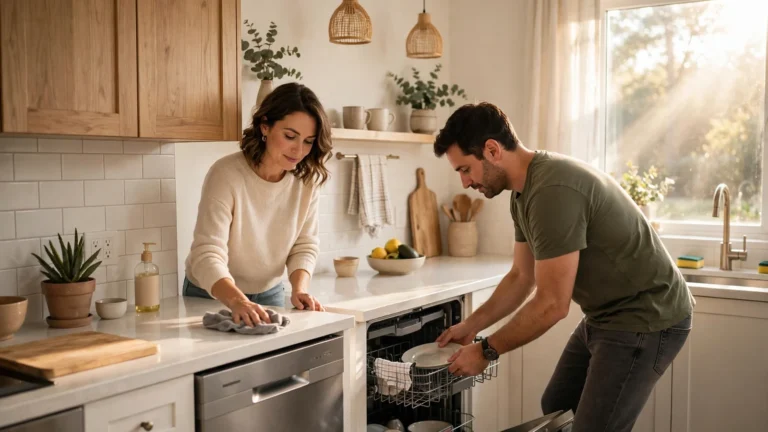
You split tasks. You cover for each other. You can run bedtime, bottles, daycare pickup, and a grocery order with almost military precision. From the outside, and honestly from the inside on a good day, it looks like you’re crushing it. And in a lot of ways you are.
But a marriage can run very well as a logistics operation and still feel empty as a relationship. That’s the trap. The household works. The closeness doesn’t get fed, because closeness doesn’t run on efficiency. It runs on the extra minute. The second sentence. The moment where one of you says something vulnerable and the other one stays in it instead of solving it and moving on.
A lot of couples recognize this pattern from when marriage starts to feel like roommates long before they have words for it. With a baby, it just happens faster, because there is always something more urgent than a conversation about how you’re actually doing. The baby is crying. The laundry is beeping. Someone has to eat. The talk about “us” keeps losing to the talk about “next.”
The good news is this trap isn’t a character flaw. It’s what happens when two exhausted people do triage all day. You don’t fall into it because you stopped loving each other. You fall into it because nobody taught you how to protect the couple part when the parent part is so loud — which is exactly what how to stay connected after becoming parents breaks down into small, doable moves.
The Identity Shift Hits Both Parents

Here’s the part that gets talked about the least, and it might be the most important. A baby doesn’t just change your schedule. It changes how you understand yourself, and it does that to both of you at the same time, often in different ways that don’t line up neatly.
One partner might feel swallowed by the new role, like the person they were — with hobbies and opinions and a job that made sense — has been put in a drawer somewhere. The other partner might feel on the outside of the baby bubble, needed for support and logistics but not sure where they fit in this new family.
Both of those feelings can be true at once, and both can make someone feel guilty for having them. The parent who is home more might think, “I should just be grateful.” The parent who goes to work might think, “I have no right to feel lonely, I’m not the one doing the hardest part.” So nobody says it out loud, and both people carry a private ache in the same house.
There’s also grief tucked inside a lot of this, and grief is a strange thing to feel next to so much love. You can adore your baby and still miss the easy version of your marriage. Missing the before doesn’t make you a bad parent. It makes you a person with a memory. Couples get into trouble when they treat that grief like a betrayal instead of what it is — a normal side effect of a huge life change that happened fast.
What Helps in the First Year

Nothing on this list requires a weekend away, a babysitter you trust with your whole heart, or more energy than you actually have. The first year is not the season for grand gestures. It’s the season for small, repeatable proof that you two are still in there.
Name the shift out loud. This sounds too simple to matter, but it matters a lot. Saying “I think we’re in the roommate phase and I don’t like it” is completely different from snapping about dishes. One is a complaint. The other is an invitation. The moment both of you can name what’s happening without making it someone’s fault, you stop being opponents in the same hard season and go back to being teammates in it.
Steal back tiny bits of “us” time. Not a date night production. Ten minutes after the baby is down, phones in the kitchen, sitting together like people who chose each other on purpose. Some nights you’ll talk. Some nights you’ll mostly sit there and breathe. Both count. For ideas that fit new-parent life, the low-pressure approach in how to reconnect with your spouse emotionally is a gentle place to start.
Lower the bar for affection on purpose. You might not have the bandwidth for big romantic energy right now, and that’s okay. A real hug in the hallway. A hand squeezed at the table. Falling asleep actually touching instead of on opposite ends of the mattress. Small physical warmth tells your bodies you’re still safe with each other, even when words are clumsy.
Say the second sentence. The first sentence is the report: “Work was fine.” The second sentence is the truth: “Work was fine, but I felt weirdly invisible in that meeting and it’s still sitting on me.” New parents get very good at reports because reports are efficient. Closeness lives in second sentences. One honest extra sentence a day can keep a thread between you that logistics alone never will.
Protect each other’s sleep like it’s relationship money. Because it is. A rested partner is kinder, funnier, and way more able to hear “I need help” without hearing “you’re failing.” Trade off. Take the early shift. Let someone nap without keeping score out loud.
Assume the best translation. When your spouse is short with you at 10 p.m., the most likely story is not “they’ve changed and they don’t love me anymore.” It’s “they are running on empty and their words came out smaller than their feelings.” That translation won’t fix exhaustion, but it will keep exhaustion from turning into a story about your whole marriage.
Maybe the most true thing anyone can tell you is this: the first year asks a lot of a marriage not because the marriage is weak, but because the change is enormous. If your marriage feels different after having a baby, that’s not a verdict. That’s information. Couples who notice it early, talk about it kindly, and keep reaching for each other in small ways tend to come out of this season not just intact, but closer in a deeper, hard-won way.
Tonight, before the next feeding or load of laundry, try asking the person next to you one real question — not about the baby, about them. What part of all of this has surprised them the most? You might be amazed what opens up when someone finally gets asked.
Frequently Asked Questions
Is it normal for marriage to feel different after having a baby?
Yes, completely. Almost every couple feels a shift in closeness, time, touch, and communication after a baby arrives. The household runs on logistics, sleep is thin, and both partners are adjusting to a huge identity change at once. Feeling different is common. Feeling permanently disconnected is not inevitable.
How long does the roommate phase last after a baby?
It varies a lot. For many couples, the most intense stretch is the first three to six months, when sleep is worst and routines are still forming. What shortens it is not time alone but noticing the pattern and adding back small moments of connection — a real conversation, a proper hug, ten minutes that are yours.
Why do I feel distant from my spouse even though I still love them?
Love and closeness are related, but they are not the same thing. You can deeply love someone and still feel like teammates more than partners when every conversation is about feeding times and errands. Distance usually comes from exhaustion, missed repair, and conversations that never get past the surface.
What is the identity shift for new parents in a marriage?
Both parents often feel their sense of self change. One may feel consumed by caregiving and unsure where their old life went. The other may feel pushed to the edges of the new family and unsure how to be needed. Naming that shift helps couples stay patient with each other.
What actually helps a marriage in the first year with a baby?
Small and steady beats big and rare. Name what’s happening without blame, protect tiny pockets of couple time, keep affection low-pressure and frequent, and guard each other’s sleep. You do not need to fix everything. You need repeated proof that you are still reaching for each other.
Keep Reading
If this hit home, these might too:
- how to stay connected after becoming parents
- when marriage starts to feel like roommates
- how to reconnect with your spouse emotionally
- can a marriage survive without romance
- how to split chores in marriage
Going through something similar?
Share your experience anonymously with the Ever After Daily community. Every story is read by a human editor before anything is published.
Share Your Story