15 Conversations to Have Before You Get Married (Beyond the Wedding Planning)
Before you pick napkin colors, have the real talks first. Fifteen honest questions to ask before marriage — on money, family, conflict, and daily life.

15 Conversations to Have Before You Get Married (Beyond the Wedding Planning)
You’ve picked the venue. The guest list is color-coded. You know exactly what shade of blush the napkins will be, and you and your fiancé had a real debate about it — a twenty-minute one, on a Tuesday, in the car, with spreadsheets.
And yet there’s a solid chance you’ve never asked each other the one question that actually matters: what does money feel like to you?
I don’t say that to scold you. Wedding planning eats the real talk alive, and it does it so politely. There’s always another vendor email to answer, another seating puzzle to solve, another thing that feels urgent because the date is circled on a calendar. The marriage, meanwhile, sits quietly off to the side, unplanned, waiting to see if anyone will give it a glance. Nobody circles that date. Nobody sends a reminder.
So consider this the reminder. These are the fifteen conversations worth having before the wedding — grouped the way real married life actually divides itself. You don’t need to have them all in one weekend. Some of them are dinner-table conversations. A few are couch-and-wine conversations. Two or three are “turn off the TV” conversations. All of them beat the napkin debate.
Money: the three conversations you’re avoiding

Money isn’t about the money. It’s about safety, freedom, and what a good life looks like — and two people can love each other deeply while holding completely opposite definitions of all three. That’s why this group comes first.
1. “How did money feel in your house growing up?” This is the question underneath every money fight you’ll ever have. Someone raised in a house where the electricity got shut off once will never relax about spending the way someone raised in a house where vacations just appeared will. Neither one is wrong. But if you don’t know which story your partner carries, you’ll spend years arguing about a restaurant bill when you’re really arguing about childhood.
Start it like this: “I want to understand how money felt to you growing up — was it scary, was it easy, was it never talked about?” A good answer is honest and specific: “My dad worked two jobs, and my mom clipped coupons at the kitchen table. I still feel guilty buying the expensive cheese.” A red flag is deflection: “It’s fine, we were normal,” repeated every time you ask. Normal is not a feeling.
2. “If we disagree on a big purchase, who gets the final say — and how?” This is the practical twin of the first question, and it matters more than it sounds. Someday one of you will want to spend two grand on something the other finds absurd. A couch. A camera. A trip. You need a rule before the day arrives, not during it.
Start it like this: “Can we make a plan for big purchases before we need one? Like a number we both agree to check in about?” A good answer sounds like partnership: “Anything over five hundred, we talk it through, and nobody sulks if the answer is no.” A red flag sounds like a veto: “I earn it, I spend it.” You’re a team now. Solo spending with a marriage attached is a trap.
3. “What would we do if one of us lost their job tomorrow?” Nobody wants to have this one during engagement season. Have it anyway, while you’re calm and optimistic, because calm and optimistic is when you make the best plans. Talk about the emergency fund. Talk about how long you’d wait before one of you takes a job you hate. Talk about what you’d cut first. Money fights are the ones that don’t have to be fights — but only if you build the playbook before the crisis. A good answer is concrete: “We’d cut the dining out, I’d pick up the extra shifts, we’d give it three months.” A red flag is pure denial: “That won’t happen to us.” It happens to plenty of people it wasn’t supposed to happen to.
Family: the conversations about the people who come with you

You are not marrying one person. You are marrying a family system, a holiday schedule, a set of expectations nobody wrote down, and possibly a mother-in-law with strong opinions about casseroles.
4. “What do holidays look like for us, for real?” Not this year — this year is already booked. The question is about year five, year ten. How often will you see each family? Whose house at Christmas? What happens when someone gets their feelings hurt? Every couple I know who fights about the holidays is fighting about an arrangement they never actually chose.
Start it like this: “Let’s imagine it’s five years from now and we’re planning Thanksgiving. What does the ideal version look like to you?” A good answer includes the other family: “Alternate years, and we protect one holiday that’s just us.” A red flag is a hostage situation: “We always do it at my parents’. That’s just how it is.” The word “always” deserves scrutiny when it’s said by one person about both people’s holidays.
5. “How involved should our parents be in our decisions?” Buying a house. Raising kids. Picking a school. Whose opinion counts, and how much? This conversation is really about boundaries, and boundaries are easier to set before a parent is standing in your kitchen offering to reorganize it.
Start it like this: “When we’re making a big decision, how much do you want your parents in the loop?” A good answer draws a clear line: “They can know, but the decision is ours, and I’ll be the one to tell my mom that.” A red flag is a loyalty test: “I tell my mom everything.” Everything includes your marriage’s private business, which is a problem you can see coming from a mile away.
6. “Do we want kids — and what if we disagree later?” This one scares people because it feels like a contract. It isn’t. It’s a window into how you each think about the future, and about what happens when two futures collide. Talk about timing, about how many, about what matters most to each of you about parenthood. And talk about the hard part: what if one of you changes your mind?
Start it like this: “I know we’re both saying yes to kids right now, but what if ten years from now one of us feels differently? How would we want to handle that?” A good answer is tender and serious: “We’d talk it through honestly, maybe with a counselor, and we’d never guilt each other.” A red flag is a shrug: “We’ll figure it out.” Some things you really should figure out now.
Conflict: how you’ll fight before you’ve had the big one

You haven’t had your first real fight yet — the ugly one, the one with raised voices and slammed doors. You will. These conversations are the difference between a fight that ends at the kitchen table and a fight that ends in a guest room.
7. “When we’re upset, do you need space or closeness?” This might be the most useful question on the whole list. Pursuers and withdrawers marry each other with remarkable consistency, and then the pursuer chases and the withdrawer runs and both feel unloved by the exact mechanism that used to work for them. One of you needs to talk it out at 11 p.m. The other needs to go silent and process until morning. Neither is wrong. But you have to know it now.
Start it like this: “When you’re really upset, what do you need from me in the first hour — space or me staying close?” A good answer is self-aware: “I shut down, but I’ll come back in an hour. Give me the hour.” A red flag is a promise to be someone else: “I’ll be fine, I’ll just talk.” They won’t. Plan for the person they are, not the person they wish they were.
8. “What does a good apology look like to you?” People apologize in completely different languages. One person needs to hear “I’m sorry” and see tears. Another needs to see the behavior change by Friday. Another needs to hear exactly what went wrong, in order. If you apologize in your language and your partner hears in theirs, you’ll both feel unheard after every single repair attempt. Learning to apologize well is a whole skill — start by learning which version your person needs.
Start it like this: “When I’ve hurt you, what actually helps — hearing the words, seeing me change something, or just time?” A good answer is specific: “Tell me what you did wrong so I know you get it, and then don’t do it again.” A red flag is absolution on demand: “You just say sorry and we move on.” Sorry is the beginning of the repair, not the whole thing.
9. “Is there anything that’s a dealbreaker if it doesn’t change?” Everyone has one. The drinking. The temper. The way he talks to waiters. The way she goes silent for days. Most engaged couples can name their partner’s dealbreaker candidate — and most of them are quietly betting it will fix itself after the wedding. It won’t. Marriage amplifies patterns; it doesn’t dissolve them.
Start it like this: “Is there anything about me — or about us — that genuinely worries you for the long run? I want to hear it now, not in year six.” This is the bravest conversation on the list. A good answer is honest and uncomfortable: “When you’re stressed you get sharp with me, and it scares me a little.” A red flag is the marriage myth: “Everything will be fine once we’re married.” That sentence has never been true for anyone.
Dreams: the life you’re both actually picturing
Weddings are one day. Marriage is ten thousand days. These are the conversations about the ten thousand.
10. “Where do you picture us living in ten years?” City, suburbs, near family, far from family — these aren’t logistical details, they’re identity questions. One of you is picturing a farmhouse; the other is picturing a downtown loft. Better to discover that over appetizers than during a lease renewal.
Start it like this: “Close your eyes. It’s ten years from now, Saturday morning. Where are we?” A good answer is vivid and shared: “A house with a yard, your brother next door, coffee on the porch.” A red flag is a solo vision: “My corner office.” If their ten-year picture doesn’t include you in any detail, pay attention to that.
11. “What does success look like to you at fifty?” This is the ambition conversation, and it’s really about how you’ll feel about each other when the highlight reel slows down. Does success mean a title? A paid-off house? Kids who call? Time to travel? If one of you is chasing a corner office and the other is chasing a porch, you’ll either negotiate it now or resent it later.
Start it like this: “Forget money for a second. When you’re fifty, what kind of life would make you say, ‘We did it’?” A good answer reaches for the same things you do: “Healthy, the kids grown and good, work we still like.” A red flag is contempt for the question: “Who cares about fifty?” You will. You absolutely will.
12. “What’s a dream you have that has nothing to do with me?” This is my favorite question on the list, because it protects the thing most marriages slowly lose: the two separate people inside the couple. A novel. A marathon. A business. A weird hobby. Marriages where both people keep one dream of their own are marriages with air in them.
Start it like this: “What’s something you’ve always wanted to do that’s just yours?” A good answer lights them up: “I’ve always wanted to learn the guitar properly. Like, actually properly.” A red flag is emptiness: “I don’t really have anything.” Everyone has something. If they can’t find theirs yet, that’s okay — but make room for it when it shows up.
Daily life: the unglamorous stuff that runs everything
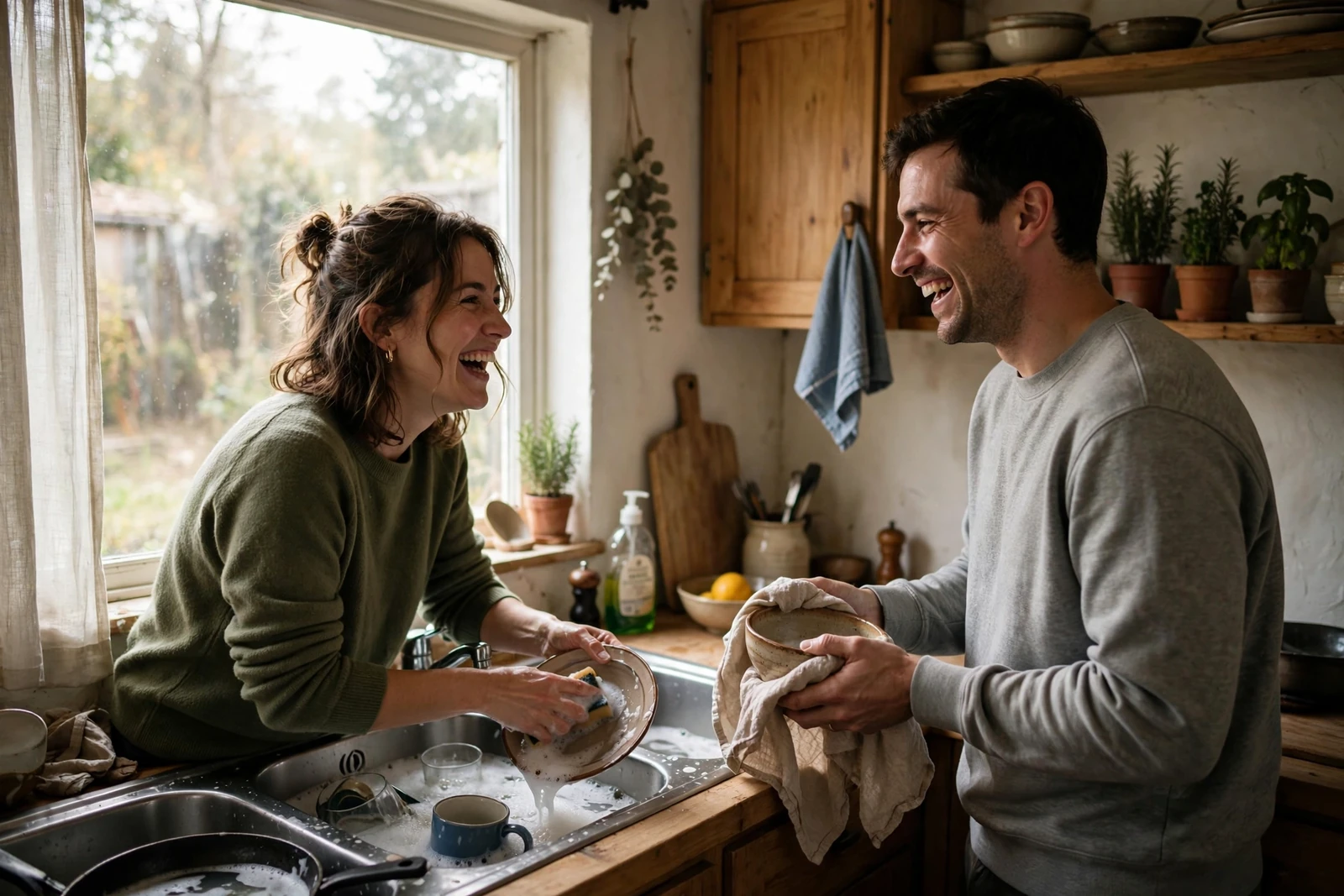
Romance gets the headlines, but marriages are won and lost in the daily logistics — the dishes, the mornings, the thousand tiny frictions that either get talked about or calcify.
13. “Who does what around the house — and how do we decide?” The chore conversation feels so unromantic that most couples skip it entirely, which is wild, because nothing breeds resentment like an unspoken chore ledger. Talk about it now: who cooks, who cleans, what “clean enough” means to each of you, and what happens when life gets busy. How you split the invisible work predicts more than the wedding flowers do.
Start it like this: “What feels like a fair split of the house stuff to you?” A good answer is flexible: “I’ll cook if you clean, and we revisit it when life changes.” A red flag is gender on autopilot: “Well, my mom always did the cooking.” You’re not marrying your parents’ marriage. You’re building your own.
14. “Are you a morning person or a night person — and what does that mean for us?” This sounds trivial. It isn’t. The morning person who wants a walk-and-talk at 6 a.m. and the night owl who does their best thinking at midnight can drive each other quietly insane for decades if they never name it. Talk about sleep schedules, alone time, and when each of you is actually available to connect.
Start it like this: “What does your ideal evening look like after a long day?” A good answer leaves room for both: “I crash by ten, but I’ll stay up till eleven on Fridays for you.” A red flag is a verdict: “You should just go to bed earlier.” “Should” is doing a lot of work in that sentence.
15. “How will we protect us when life gets loud?” Kids, careers, aging parents — the loud years are coming for every couple. The question is whether you’ll have a plan or just a hope. Talk about date nights, about how you’ll check in when you’re both exhausted, about what “us time” is non-negotiable even in the busiest season. The couples who make it through the loud years are the ones who planned for them.
Start it like this: “When life gets crazy — and it will — what’s the one thing we promise to protect?” A good answer names something concrete: “Friday night. No phones, just us, even if it’s takeout on the couch.” A red flag is romance as autopilot: “We’ll be fine, we love each other.” Love is the reason to protect it, not the protection itself.
How to start the awkward ones
Pick the conversation, not the moment. Don’t ambush your fiancé with “What if you change your mind about kids?” in the middle of cake tasting. Try a walk, a long drive, the couch after dinner — anywhere the conversation can breathe.
Use the gentlest version of the question. Every question above is written to open a door, not to accuse. “How did money feel growing up?” lands completely differently than “Why are you so cheap?” — and you already know which one gets an honest answer.
And listen for the feeling under the words. When your partner says they don’t care where you live, but their voice gets tight — that’s the real answer. The words say “wherever.” The voice says “please don’t move me away from my family.” Trust the voice.
One more thing: none of these conversations need to end in agreement. They need to end in understanding. You’re not looking for a partner who matches you on all fifteen. You’re looking for a partner who’ll sit on the couch and talk through all fifteen with you — honestly, kindly, without running. That willingness? That’s the whole ballgame.
FAQ: questions to ask before marriage
We keep meaning to have these talks but wedding planning eats everything. What do we do?
Schedule them. Literally. One conversation per week, fifteen weeks, done before the wedding. Put it on the calendar like a vendor meeting — because it matters more than any vendor. Sunday evenings, phones away, one question. You’ll be amazed how much lighter the wedding planning feels once the marriage part has some air.
What if we disagree on something big, like kids?
Disagreement isn’t the problem — unspoken disagreement is. A couple that disagrees about kids and talks about it honestly, maybe with a counselor, has a real shot. A couple that disagrees and buries it has a time bomb. If a disagreement won’t resolve through talking, that’s what premarital counseling is for, and going is a sign of strength, not trouble.
Is it too late to have these conversations if we’re already married?
It’s never too late. Married couples have these conversations all the time — usually one crisis at a time, which is harder but still works. If you skipped the money talk before the wedding, have it this weekend. The only bad time to start is never.
What if my partner shuts down when I bring up serious topics?
Name the pattern gently, not the topic. “I’ve noticed it’s hard for us to talk about serious stuff, and I want us to get better at it — can we try just one small conversation?” If shutdown is the response to everything, including this, consider premarital counseling before the wedding. A partner who won’t talk about talking is telling you something important.
Should we do premarital counseling even if things are great?
Yes — especially if things are great. Counseling when you’re happy is like a tune-up instead of a repair. A good counselor will hand you questions you didn’t know to ask and watch how you answer them, which is worth more than any checklist. Many couples say it was the best wedding expense they never put on the registry.
What conversation did you wish you’d had before the wedding?
Every married couple has one — the talk they skipped, the question they didn’t ask, the thing they assumed would work itself out. I’d love to hear yours. What do you wish someone had handed you before your wedding day, and what would you tell an engaged couple reading this right now?
Drop it in the comments. The couple color-coding their napkins this week needs your wisdom more than any seating chart.
Keep Reading
If this hit home, these might too:
- money conversations every couple should have
- how to budget as a couple without fighting
- how to split chores in marriage
- things happily married couples do
- how to talk to your spouse about feelings
Going through something similar?
Share your experience anonymously with the Ever After Daily community. Every story is read by a human editor before anything is published.
Share Your Story