What Each Season of Marriage Teaches a Couple
Spring, summer, fall, winter: a long marriage moves through seasons of its own. What each one teaches a couple about love, patience, and staying close.

What Each Season of Marriage Teaches a Couple
A marriage has seasons, the same way a year does. Not the weather, though the weather plays a part. The seasons of a marriage are the stretches of life that change how two people live together: the new years, the busy years, the slowing years, the quiet years. Each one feels different when you are in it, and each one teaches something the others cannot.
Nobody tells you this at the wedding. You stand there in your best clothes and you think the feeling of that day is the marriage, and it is, for a while. Then the seasons start to turn, and you learn that a marriage is not one feeling kept alive. It is a series of seasons, and each one asks something different from the two of you. The couples who last are not the ones who freeze one season in place. They are the ones who learn what each season is trying to teach them, and who carry that lesson into the next one.
Spring: everything new, everything possible

Spring is the beginning, and spring feels like the whole world is opening. Everything is new: the apartment, the furniture, the way you split the chores, the first time you cook a meal together and burn it and eat it anyway. You are learning each other in real time, and every small discovery feels like a gift. You learn that he hums when he washes dishes. You learn that she needs ten minutes of quiet with coffee before she can talk. You learn that the way you fold a towel matters to someone, and you laugh about it, and then you fold it their way.
Spring teaches a couple how to pay attention. That is the whole lesson, and it is a bigger one than it sounds. In spring, you are watching each other closely, because everything is new and you want to get it right. You notice the small things: the way they take their coffee, the song they hum, the look on their face when they are tired. Attention is easy in spring because it is new. The trick is remembering that it was never supposed to stop.
Spring also teaches you that a marriage is built in the small hours, not the big ones. The wedding was a day. The marriage is a Tuesday night, a load of laundry, a walk to the store, a pot of soup on the stove. The couples who do well in spring are the ones who treat the ordinary days like they matter, because they do. A simple evening ritual starts here, in spring, when two people are still deciding what their life together looks like.
Say it to each other in spring, out loud, while it is still true: “I am still learning you, and I like what I am finding.” That sentence costs nothing, and it is the kind of sentence that keeps a marriage honest for years.
Summer: the busy years

Summer is the busy season, and it lasts longer than any other. The kids come, or the careers take off, or the house needs a roof, and suddenly there are not enough hours in the day. You are both tired, both pulled in ten directions, and the marriage runs on autopilot for a while. You eat dinner in shifts. You talk about schedules and bills and who is picking up the kids. You fall asleep on the couch with the television on. Summer is hot, bright, full, and exhausting.
Summer teaches a couple how to stay close when there is no time to be close. That is the lesson, and it is the hardest one in the whole marriage, because closeness in summer does not look like closeness in spring. It does not look like long talks and slow evenings. It looks like a hand on a shoulder in the hallway. It looks like one of you making coffee for the other without being asked. It looks like a text at lunch that says, “Thinking of you,” sent between meetings. The couples who stay close in summer are the ones who learn that five minutes counts, and that a small gesture, repeated, is worth more than a grand gesture that never happens. The habits that carry a marriage through the busy years are small ones, the kind that happily married couples keep doing even when life is full.
Summer also teaches you to fight fair, because you will fight, and the fights in summer are tired fights. You are both worn out, and the smallest thing can start an argument: the dishes, the laundry, the way one of you left the car on empty. The lesson is not to stop fighting. The lesson is to stop fighting about the dishes when the real problem is that you are both tired. Name the tiredness, out loud, before the argument starts. “I am worn out, and I am taking it out on you, and I am sorry.” That sentence has ended more summer fights than any apology after the fact.
And summer teaches you to let the other person be tired without fixing it. Some nights, the best thing you can do for your spouse is to leave them alone with a book and a quiet house for an hour. Love in summer is often spelled with space: an hour alone, a walk by yourself, a night where nobody needs anything from you. Give it freely, and take it when you need it, and do not keep score.
Fall: slowing down and letting go

Fall comes slowly, and you notice it in the small changes. The kids leave, or they grow up and need you less. The career slows down, or the house gets quieter. The pace drops, and for the first time in years, you have time to look around and see who is sitting across the table from you. Fall is the season of letting go, and it is harder than it looks, because letting go feels like losing something, even when it is really making room.
Fall teaches a couple how to be two people again, after years of being two parents, two coworkers, and two caretakers. You have spent years being needed, and being needed gave you a shape. When the needing slows down, you have to find a new shape, and you have to find it together. That means asking a question you have not asked in years: “What do we want to do now?” The answer might be travel, or a garden, or a class, or nothing at all for a while. The answer matters less than the asking. A couple facing the empty nest knows this season well, and the ones who do it best are the ones who treat it as a beginning, not an ending.
Fall also teaches you to let go of the version of your spouse you married. The person across the table is not the twenty-five-year-old you stood next to at the altar. They have changed, and so have you, and fall is the season when you finally have time to notice. Letting go of the old version is not betrayal. It is the only way to love the person who is actually there. Ask them who they are now, and listen to the answer like it is new, because it is.
There is grief in fall, and it is honest to name it. You miss the noise of the full house. You miss being needed the way you were needed. You miss the version of your life that just ended. Grieve it together, out loud, and then look at what is left: two people, a quiet house, and more time than you have had in years. That is not an ending. That is a season with room in it.
Winter: quiet, closeness, and what remains
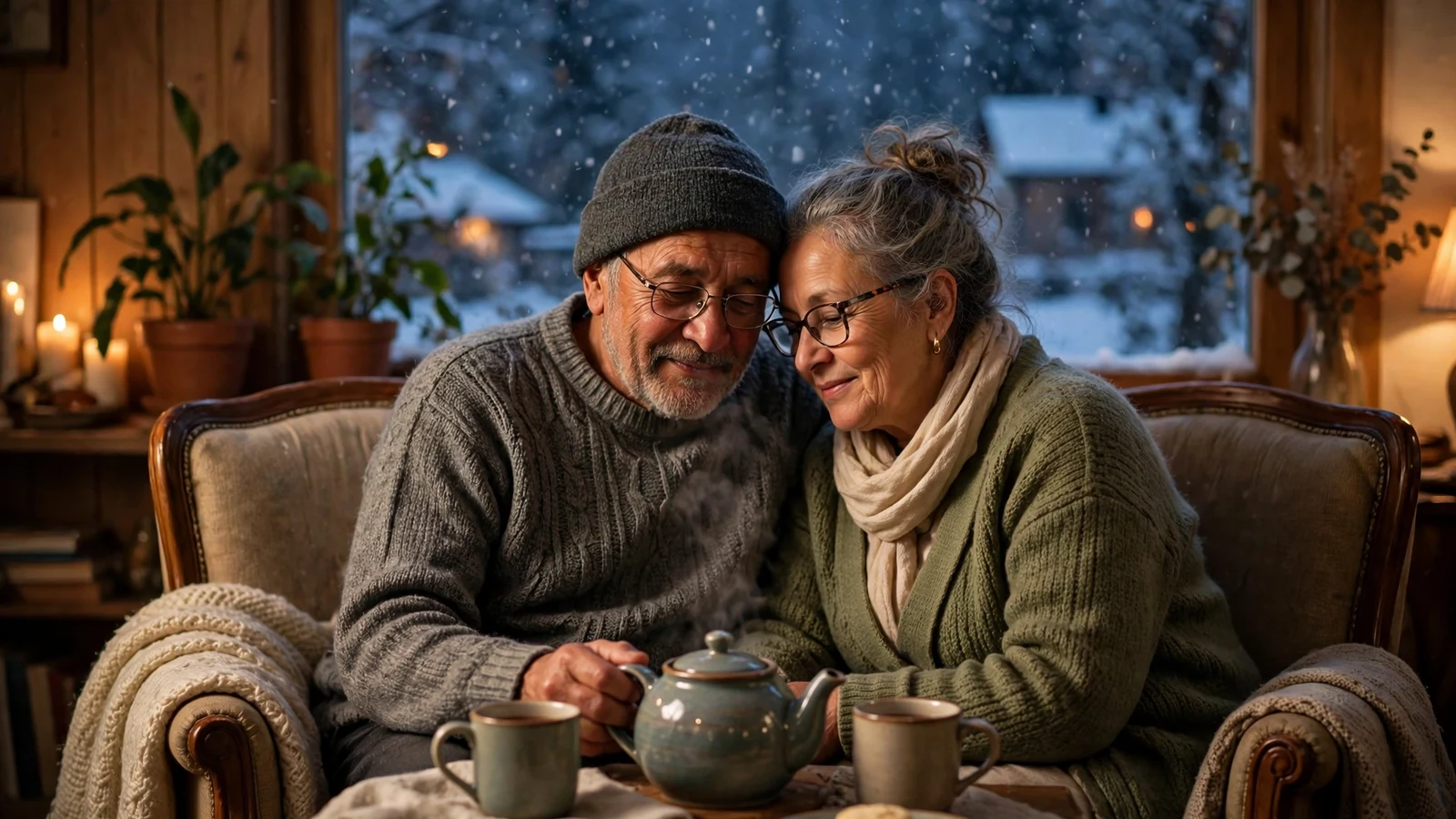
Winter is the quiet season, and it is the one that surprises couples the most. The house is small now, or the days are short, or the body aches a little more than it used to. You spend more time together than ever, in a smaller space, with fewer distractions. Winter can feel lonely, even with another person in the room, because the quiet is so complete. And winter can feel closer than any season before it, because there is nothing left between you and the person you married except the two of you.
Winter teaches a couple what remains when everything else is gone. The career is over, or winding down. The kids have their own lives. The house is paid for, or nearly. What is left is a person who knows you better than anyone alive, who has seen you at your worst and stayed, who remembers the spring you and the summer you and the fall you. That is what winter gives you: a witness to your whole life, sitting across the table, drinking the same coffee, reading the same newspaper. A marriage that has lasted learns how to stay in love not by chasing the feeling of spring, but by finding the feeling that only winter can give: the feeling of being fully known.
Winter also teaches you to be gentle. Bodies ache, tempers shorten, patience thins, and the small things that never bothered you can start to grate. Be gentle with each other, and be gentle with yourself. The couple that makes it through winter is the couple that learns to say, “You are doing your best, and so am I,” and means it. That sentence is worth more in winter than any grand speech.
And winter teaches you to keep one small ritual alive, whatever it is. A walk, a book, a bench at the top of a hill, a cup of tea at four in the afternoon. The ritual does not need to be impressive. It needs to be yours, and it needs to happen, every day, even when the weather is bad and the mood is worse. The ritual is the thread that holds the seasons together. It is the thing you carry from spring to summer to fall to winter, and it is still there when you need it most.
A marriage is not one season. It is all four, in order, over and over, each one teaching you something the others could not. Spring teaches attention. Summer teaches closeness without time. Fall teaches letting go. Winter teaches what remains. Learn them as they come, and the marriage keeps growing, season after season, year after year.
Frequently asked questions
How do I know which season of marriage we are in?
Look at what fills your days. If everything is new and you are still learning each other, that is spring. If life is full and you are both tired, that is summer. If the house is getting quieter and you are asking what comes next, that is fall. If the days are quiet and you spend most of your time together, that is winter. Most couples can name their season in one sentence once they look.
Can a marriage go back to an earlier season?
Yes, and it often does. A new hobby can feel like spring. A new grandchild can bring back the busy joy of summer. Seasons in a marriage are not a straight line. They circle back, and each return teaches you something you missed the first time around.
What if my spouse and I are in different seasons?
Then talk about it, out loud, at the kitchen table, without blame. One of you might be ready for fall while the other is still holding on to summer. Naming the difference is the first step. The seasons only work when both people know which one they are in.
Which season is your marriage in right now, and what has it taught you so far? Tell us in the comments, if you are willing. Your answer might help another couple name the season they are standing in.
Going through something similar?
Share your experience anonymously with the Ever After Daily community. Every story is read by a human editor before anything is published.
Share Your Story