Alone Time in Marriage: How Much You Actually Need (and How to Ask for It)
Wanting an hour alone in a good marriage can feel like betrayal. It is not. How much solitude is actually normal, how to ask for it, and how to give it back.

Alone Time in Marriage: How Much You Actually Need (and How to Ask for It)
It is three o’clock on a Saturday. The house is full in the way houses get full: kids arguing over a game, your husband on a call in the kitchen, the dog barking at the mail carrier like it is a home invasion. You love every person under this roof. And the thought slides through your head anyway, quiet and shameful: I wish everyone would leave for one hour.
Then the guilt arrives right behind it, fast and familiar. What kind of wife wishes her family away? What kind of marriage is this, if an hour alone sounds better than all of this togetherness?
Let me say the thing nobody says out loud enough: wanting an hour alone is not a verdict on your marriage. It is maintenance. The same way sleep is not a verdict on your love of being awake.
The guilt nobody talks about
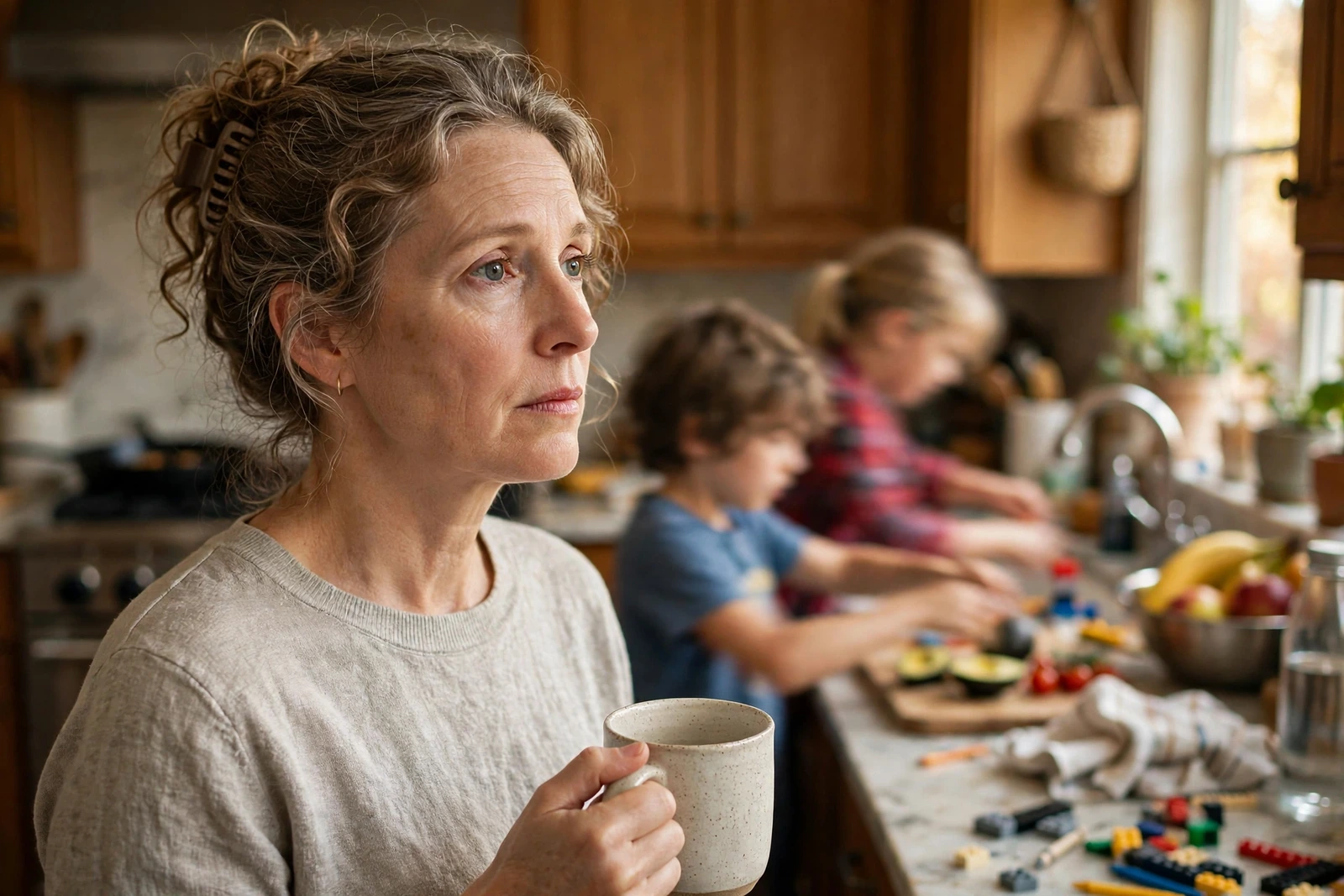
The guilt is the real story here, not the solitude. Almost every married person who craves alone time has rehearsed the same shame spiral. I should be grateful. Other people would kill for this family. Something must be wrong with me.
Nothing is wrong with you. A marriage does not erase the person who entered it, and that person still has a nervous system that gets tired. Noise accumulates. Requests accumulate. Being needed, even lovingly, is still being spent. The hour you want is not an escape from your people. It is the pause that lets you enjoy them again.
If your spouse is the one asking for the hour and you are the one feeling stung by it, read if your spouse needs alone time before you take it personally. That piece is for the partner on the receiving end. This one is for the person doing the asking, and for the guilt that comes with it.
So how much is normal?

Here is the honest answer: there is no number, and anyone who gives you one is guessing. No study, no rulebook, no magic weekly quota. What is normal is whatever leaves you coming back lighter.
The seasons of a marriage change the math completely. New parents might get twenty stolen minutes on the porch after bedtime, and that is plenty. Empty nesters might each take a whole Saturday morning and meet for lunch like people dating again. An introvert married to an extrovert might need a daily hour the way other people need coffee. None of these are signs of trouble. They are signs of a marriage adjusting to real life.
The better question is not “how much” but “is it working?” Two tests. One: do you come back kinder? If the hour leaves you softer, funnier, more present, it is doing its job. Two: does your spouse get the same? Solitude that flows one way eventually curdles into resentment. We will get to that.
And one flag worth naming: if you want to be alone all the time, that is a different conversation. An hour that restores you is maintenance. A life spent avoiding your spouse is a signal. This piece is about the first one. If you are living the second one, marriage feels like roommates is the more honest place to start.
How to ask for it

Timing matters more than wording. Don’t ask mid-argument, mid-chaos, or while slamming cabinet doors. Ask in a calm moment, ideally the night before or that morning, when it sounds like planning instead of fleeing.
The script: “I love our Saturdays, and I need an hour on my own this afternoon so I can show up well tonight. What time works for you?”
Four things are doing work in that sentence. “I love our Saturdays” says this is not about them. “I need an hour on my own” is specific and finite, not a vague withdrawal. “So I can show up well tonight” connects the solitude to the marriage, because it is connected. And “what time works for you” makes it a plan you build together, not a door you slam.
What not to say: “I need to get away from you people.” Even as a joke, especially as a joke. Jokes are how tired people tell the truth, and your spouse knows it. Also skip the over-explaining. You do not need a medical excuse or a three-paragraph justification. “I need an hour” is a complete sentence. The more you defend it, the more it sounds like you believe you are doing something wrong.
The give: make it reciprocal

Here is where most couples quietly go wrong. She takes the hour, feels restored, and never thinks to offer it back. He watches, says nothing, and files it away. Six months later it surfaces in a fight about something else entirely, wearing a costume.
Reciprocity is the whole game. If you take an hour on Saturday, protect his hour on Sunday. Ask him what his version looks like. It might not look like yours. Hers is a walk with a podcast. His is the garage with the radio on. Hers is the bath with the door locked. His is a solo drive with nowhere to be. The shape does not matter. The fairness does.
This is also where tiny ways to say I love you earns its keep. The return from your hour is a small gesture: you come back and you are glad to see them, and you show it. A real hug. An actual question about their afternoon. The hour works best when the reunion is warm, because then solitude stops looking like distance and starts looking like what it is: the thing that keeps you close.
Ideas for the hour
If you have forgotten what to do with unstructured time alone, you are not alone in that. Years of marriage can atrophy the muscle. Some starting points:
A walk around the neighborhood with no destination and no podcast, just your own thoughts catching up with you. The porch with coffee and twenty minutes of doing absolutely nothing, which is harder and better than it sounds. A bath with the door locked and the phone in another room. Wandering a bookstore or a garden center with no list. Journaling, the unglamorous kind, where you write the sentence you would never say out loud and then close the notebook. A nap in the middle of the day like a person who trusts the world to keep spinning.
The rule for the hour: it has to be yours. Not errands. Not “alone time” spent folding laundry while everyone leaves you alone, which is just chores with better lighting. Yours.
Solitude is maintenance, not escape
A marriage is a long, shared life, and long shared lives need air. The hour you take does not subtract from your marriage. It is one of the things the marriage is made of, right alongside the shared dinners and the inside jokes and the hand reached for in the dark.
So stop apologizing for the thought you had at three o’clock on Saturday. Name it, ask for it, give it back in equal measure, and come home to your people lighter than you left.
Tell me in the comments: what does your hour look like, and was asking for it ever harder than it needed to be? Someone reading this tonight is rehearsing the sentence. Your story might be the one that gives her the words.
Keep Reading
If this hit home, these might too:
- if your spouse needs alone time
- it is okay to need a break from your marriage
- talk to your spouse about feelings
- tiny ways to say I love you
- marriage feels like roommates
Going through something similar?
Share your experience anonymously with the Ever After Daily community. Every story is read by a human editor before anything is published.
Share Your Story