The Couple Who Dances in the Kitchen Every Night
After the dishes, one couple puts on a single song and dances in the kitchen for two minutes. Here is how the habit started and how to begin your own.

The Couple Who Dances in the Kitchen Every Night
Every night, around nine o’clock, the same small scene plays out in one ordinary kitchen. The dishes are done, or close enough. The dishwasher hums. One of them reaches for the little speaker on the windowsill, the one that has lived there since they moved in, and puts on a single song. Then they dance. Two minutes, right there between the stove and the fridge, in socks, sometimes still holding a dish towel. No audience, no lesson, no occasion. Just a song, and each other, before the night winds down.
It sounds almost too small to matter. That is the whole point. A marriage is mostly made of small, repeated moments, and this couple stumbled into one that stuck. Here is how it started, why it held when fancier habits did not, and how you can start your own version without turning it into a project.
The scene: dishes, one song, two minutes
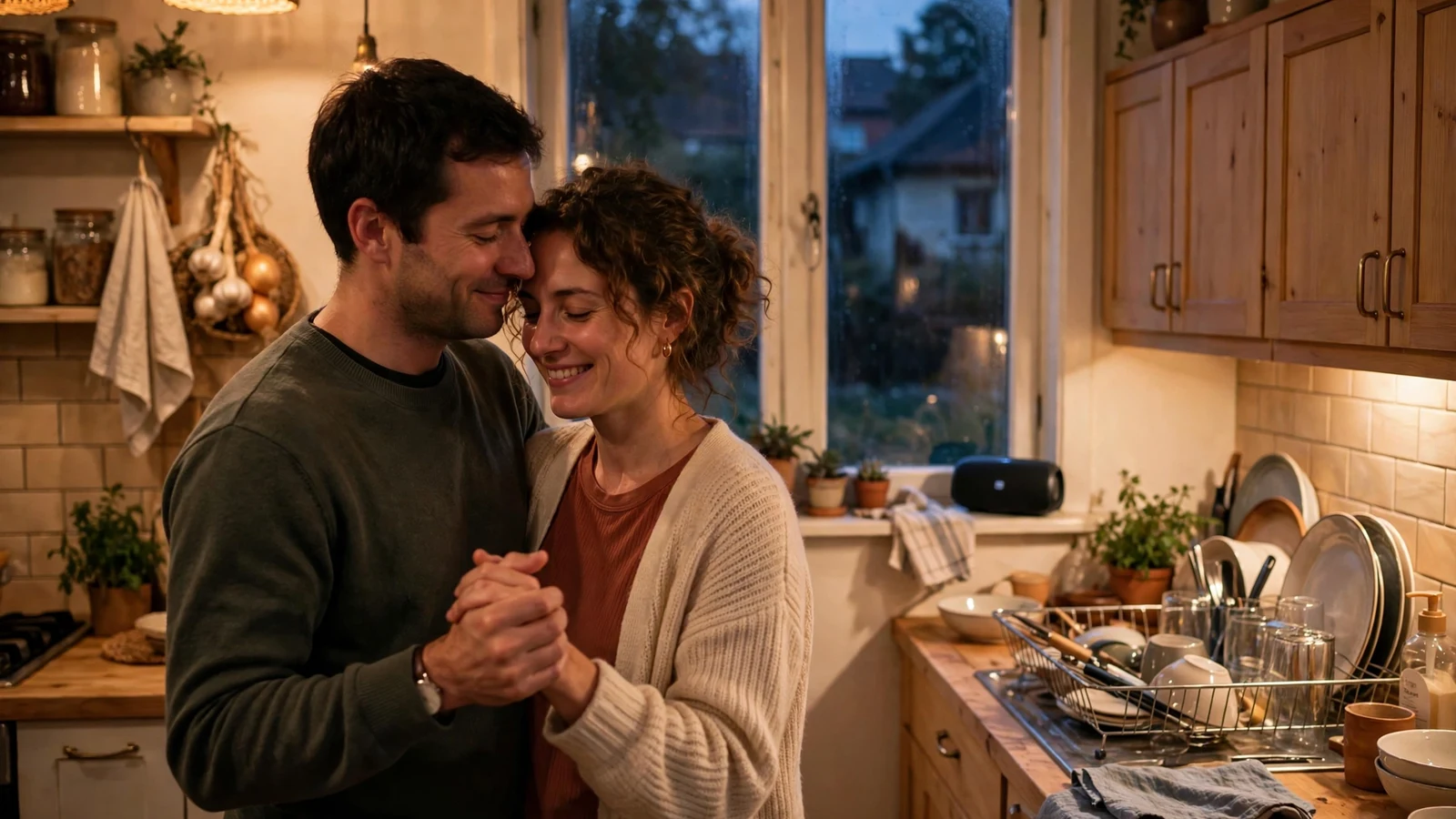
The rules of the dance are simple enough to fit on a sticky note. One song, picked by whoever reaches the speaker first. Two minutes, give or take, because nobody is timing it with a stopwatch. Dishes first, or at least started, so the dance feels like a reward rather than a delay. The kitchen stays the kitchen: the mail is still on the counter, the dog is still asleep by the back door, and the dance happens in the middle of all of it.
What it looks like from the outside is gloriously unimpressive. He spins her once and nearly clips the open dishwasher door. She laughs and steps on his foot, and he laughs too. Sometimes they sway in place, foreheads nearly touching, too tired for anything fancier. Sometimes the song is fast and they bounce around like teenagers, and the dog lifts its head, considers the situation, and goes back to sleep.
That lack of polish is doing real work. A ritual that demands skill or a good mood will die on the first tired Tuesday. A ritual that only demands two minutes and a willingness to look a little silly will survive almost anything, including bad days, colds, and weeks when the house is a mess. The dance does not ask the couple to feel romantic first. It lets the feeling catch up after the music starts, and most nights, it does.
How it started, by accident

Nobody planned this. There was no anniversary speech, no promise, no new year’s resolution. One night, years ago, the radio was on while they cleaned up after dinner, and a song they both loved came on. He held out a hand, half joking, and she took it. They danced around the kitchen island, laughed at themselves, and finished the dishes. The next night, one of them said, “Same song?” and they did it again.
By the third night it was already a thing, though neither of them would have called it that. By the second week, skipping it felt odd, like forgetting to lock the front door. It never got announced or explained to anyone. Friends who stayed for dinner and caught the tail end of it just smiled, and the couple shrugged, as if to say, this is what we do now.
That accidental start matters, because it explains why the habit never felt like homework. It was not a fix for a problem, and it was not a test either of them could fail. It began as a joke that felt good, and it kept going because it kept feeling good. Couples who try to install a grand new ritual from scratch often quit in a week, because a grand ritual has to justify itself. A small accident only has to be pleasant, and pleasant is easy to repeat.
Why a tiny ritual holds

The dance holds for three plain reasons. First, it needs no skill. Neither partner took lessons, and neither partner is keeping score about who leads better. A ritual that anyone can do on a tired night is a ritual that actually happens on tired nights, which are most nights.
Second, it has no audience. Nobody films it, nobody posts it, and nobody performs it for guests. The moment a private habit becomes a show, it gains pressure, and pressure kills play. The kitchen dance stays theirs alone, and that privacy is part of why it still feels safe after years. A couple can be silly in private in ways they would never be in public, and silliness is a kind of closeness all its own.
Third, it is tied to something that already happens. Dishes happen every night, so the dance has a built-in cue. Couples who tie a new habit to a fixed part of the day, like the evening meal, do far better than couples who leave it floating. Our guide to an evening ritual for couples makes the same point: the habits that last are the ones with a time and a place already waiting for them.
There is one more reason, quieter than the rest. The dance gives the couple a daily moment of touch that is not about asking for something. No chore request, no hard talk, no “we need to discuss” opener. Just a hand held, a spin, two minutes of being near each other for no reason at all. In a long marriage, that kind of touch can get crowded out by logistics, and a daily two minutes keeps it from disappearing entirely.
Start your own kitchen dance

If you want your own version, keep it as small as theirs. Pick a cue you already have: dishes done, dinner plates cleared, or the last mug washed. Pick one song, not a playlist, because choosing from a playlist takes time and turns a two-minute habit into a debate. Let whoever reaches the speaker first choose, and alternate nights if one partner always grabs it.
Agree on two things before the first dance, and only two. First, either partner can say “not tonight” without a guilt trip, because a ritual that punishes a skip will not survive a sick week. Second, no filming and no audience until both of you want one, which may be never. That privacy is what keeps it fun.
Then just start, tonight, even if it feels awkward. Awkward is normal for the first few dances. Step on each other’s feet. Laugh about it. Sway in place if a spin feels like too much. The goal is not a good dance. The goal is two minutes, one song, and a small moment that belongs only to the two of you. If it feels good, do it again tomorrow. If it does not, change the song, change the time, or drop it without a verdict. Some couples find their version in the living room after the news, or on the porch in summer, and that counts just as much.
A small daily gesture like this pairs well with other tiny habits that keep a marriage warm. Our list of tiny ways to say I love you has more ideas that cost nothing and take minutes, for couples who want a few more small moments in the day.
So, what is your version of the kitchen dance, the tiny habit you already have or the one you want to try? Tell us in the comments, and if you try the two-minute dance tonight, come back and tell us which song you picked.
Frequently asked questions
Do we need to know how to dance?
No, and that is the point. The couple in this story never took a lesson, and most nights they just sway or bounce around the kitchen. Skill would only add pressure. Two minutes of moving together, however clumsy, is the whole ritual.
What if my spouse thinks it sounds silly?
It is silly, and saying so out loud helps. Try it once as a joke, after the dishes, with one song you both like. If your spouse still hates it, drop it without a fight. A ritual only works when both people enjoy it, and there are plenty of other small habits to try.
What if we miss a night?
Nothing happens, and that is the rule that keeps it alive. A skipped night is not a failed week. Just pick it up the next night, or the night after, without keeping score. The dance works because it forgives a miss, not because it demands perfection.
Keep Reading
If this hit home, these might too:
Going through something similar?
Share your experience anonymously with the Ever After Daily community. Every story is read by a human editor before anything is published.
Share Your Story