The 10-Minute Evening Ritual That Keeps Couples Close
If you feel like ships passing at night, try this 10-minute evening ritual: one real question, one touch, one small gratitude. Same spot, every night.

The 10-Minute Evening Ritual That Keeps Couples Close
He comes through the door at 6:40, keys in the bowl, shoes kicked toward the wall. She is already reheating leftovers, half listening to a podcast, half thinking about tomorrow’s school lunches. They eat. He clears the table while she loads the dishwasher. He settles onto the couch with his phone. She folds laundry in the bedroom. At 10:15 she says, “How was your day?” From the couch he says, “Fine.” She says, “Mine too.” The lamp clicks off.
If that sounds familiar, here is the part nobody tells you: nothing is wrong with this marriage. And it is still drifting.
Most couples do not lose closeness in one big dramatic moment. They lose it in a thousand ordinary evenings, each one fine, each one slightly further apart. This article is about one small ritual that stops the drift. Ten minutes. Same spot. Every night.
The honest frame: closeness is a daily deposit

We tend to treat closeness like a vacation. Something we withdraw in big gulps, once or twice a year, when we finally get a weekend away or a rare night out without the kids. The rest of the year we run on fumes and wonder why the tank is empty by October.
It works the other way. Closeness is built in daily deposits, small and boring and repeated. A touch on the shoulder while the coffee brews. A real answer to a real question. A thank-you that names something specific. None of these feel like much on any given night. Stacked over months, they are the whole account.
That is the frame for everything below. You are not trying to fix your marriage in ten minutes. You are making a small deposit, every single evening, in the same place, until it becomes the most reliable part of your day. If reconnecting with your spouse emotionally has felt like too big a project to start, this is the smallest possible first step.
The ritual: one question, one touch, one gratitude

Here is the whole thing. Ten minutes, same spot every night. The couch after the dishes. The porch swing. The foot of the bed. Pick one and stay there. The spot matters because your brain starts to associate that place with this feeling, and after a couple of weeks your shoulders will drop the moment you sit down.
Three parts. In this order.
One real question
Not “how was your day.” That question is broken, and we all know it. It gets “fine” because it asks for a summary nobody has the energy to give at 10 p.m.
A real question is specific enough to have a real answer. Here are exact ones you can borrow tonight:
- “What was the hardest part of today, honestly?”
- “What are you carrying right now that you have not said out loud?”
- “What is one thing that went better than you expected today?”
- “What do you need from me tomorrow that would make the day easier?”
One person asks. The other answers. Then you switch. No fixing, no advice, no “well, you should have.” Just listening. If advice is truly wanted, the person will ask for it. Most nights, being heard is the whole point.
Write three or four of these on index cards and leave one on your spouse’s pillow. It sounds corny. It works anyway.
One physical touch
Not a grand romantic gesture. A small, deliberate one. Feet tucked under the same blanket on the couch. A hand on a knee while the other person talks. Foreheads touching on the porch swing for thirty seconds. His hand on the back of her neck while they stand at the sink.
Touch is the fastest channel couples have, and it is usually the first one to go quiet. You can say all the right words, but if your bodies have stopped touching outside the bedroom, something in the marriage goes a little numb. This part of the ritual keeps the line open. Tiny gestures like this one do more heavy lifting than most couples realize.
One small gratitude
Name one specific thing your spouse did today, or is, that you noticed. Small is the whole point. Big gratitudes (“I am grateful for our marriage”) are fine but they float. Small ones land.
- “You filled my water bottle before my run this morning. I noticed.”
- “Thank you for handling the school email. I was dreading it.”
- “You laughed at my dumb joke at dinner and it made my whole evening.”
Specific beats sweeping every time. It tells your spouse: I see you. Not the idea of you. You, on this particular Tuesday.
Variations for real life
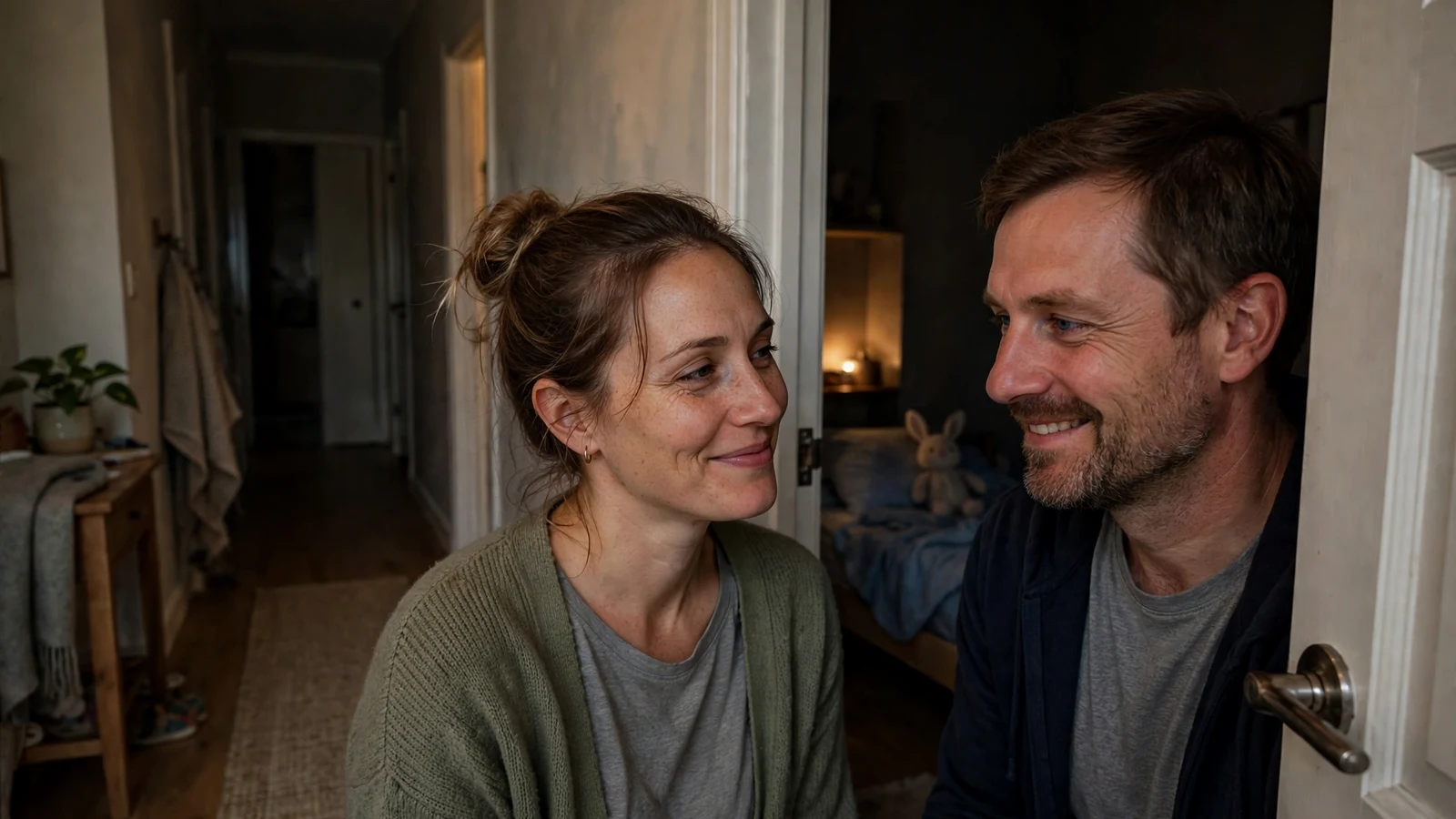
The ritual bends. It does not break.
Kids in the house. Do it after bedtime, in the same spot. If bedtime is chaos, do it on the porch after the kids are down, or in the kitchen with the last of the tea. The point is a pocket of the evening that belongs to the two of you. Even five minutes counts when the alternative is zero.
Opposite schedules. He works nights, she works days. Fine. The ritual moves. Maybe it is ten minutes in the morning before she leaves, coffee in the same two mugs. Maybe it is a voice note each, same three parts, listened to before sleep. Same spot helps but same rhythm matters more.
Long-distance weeks. Business trip, family emergency, whatever pulls you apart for a stretch. Same time every night, phones only, no multitasking. One question each, one gratitude each. The touch part waits. The rest of it does not need to.
The nights it will not happen. Someone is sick. A kid has a fever. Work ran to midnight. Skip it without a speech. The ritual survives missed nights. It does not survive guilt lectures about missed nights. Just pick it up tomorrow.
What this quietly fixes
Remember the exchange from the top of this article? “How was your day?” “Fine.” That loop is not a communication problem. It is a doorway problem. The question is too wide, the hour is too late, and both people are too tired to walk through it.
The ritual fixes the doorway. A specific question is easier to answer than a general one. A set time means nobody has to find the right moment. A familiar spot means nobody has to gear up for a Talk with a capital T. You are not scheduling emotional labor. You are just sitting in the same place you always sit, asking the kind of question that has an answer.
Over time, something else shifts. Couples who do this start telling each other small things during the day, because they know there is a place for the rest tonight. The pressure comes off every other conversation. The evening stops being the only container for everything unsaid. Roommate drift usually starts with exactly this loop going unanswered for months. Catching it nightly keeps it from hardening. And quietly, underneath all of it, emotional trust gets rebuilt — not by grand gestures, but by a thousand small kept promises, nightly, in the same spot.
How to start tonight

Do not announce a new program. Do not sit your spouse down and explain the three parts with a diagram. Programs make people brace.
Tonight, do this. Shoes off. Phones in the other room, both of them, on silent. Sit in the spot. Say, “I want to try something. Ten minutes. I will ask you one question and you ask me one, and then we go to bed.”
Then ask the question. Listen all the way to the end. Answer yours honestly. Touch on purpose. Name the small gratitude. Get up and go to bed.
Tomorrow, do it again. That is the whole launch plan.
Frequently asked questions
What if my spouse thinks this is cheesy?
Say so out loud and do it anyway. “I know this feels cheesy. I want to try it for two weeks and then we can laugh about it together.” Most people who roll their eyes at the idea stop rolling them around night four, when they realize they look forward to it. Cheesy is just what closeness looks like before it becomes a habit.
What if we miss a night, or a week?
Pick it up without the guilt lecture. The ritual is a rhythm, not a streak. Guilt turns a good habit into an obligation, and obligations are what couples avoid. A missed night is nothing. A missed night plus a scolding is the thing that kills it.
How is this different from just talking to each other?
Just talking has no doorway. It happens whenever, which usually means never, or it happens during a fight, which means it goes badly. The ritual gives the talking a time, a place, and a shape. That structure is the difference between “we should talk more” and actually talking more.
What if one of us works nights and we never overlap?
Move it, shrink it, or split it. A morning version with coffee counts. A voice note version counts. The parts matter more than the setting: one real question, one deliberate touch when you can, one specific gratitude. Do the version that fits your actual life, not the version in this article.
Tell me what your ten minutes look like
If you try this, I want to hear how it goes. What question did you ask on night one? Where is your spot? Did your spouse roll their eyes, and did they stop? Drop it in the comments. And if you have your own version of a nightly ritual, share it. Somebody reading this is sitting on their couch right now, scrolling, and your idea might be the one that finally gets them to put the phone down.
Keep Reading
If this hit home, these might too:
- reconnecting with your spouse emotionally
- Tiny gestures like this one
- Roommate drift
- the signs of a strong marriage
- when marriage starts feeling boring
Going through something similar?
Share your experience anonymously with the Ever After Daily community. Every story is read by a human editor before anything is published.
Share Your Story