Close Without Sharing a Workout
You do not have to share a workout to stay close. Different paces and different joys can still leave room for a shared walk and a check-in that keeps you close.

Close Without Sharing a Workout
She runs at six in the morning, before the house wakes up. He lifts weights after work, in a garage gym with a radio playing old rock. For years, well-meaning friends told them they should work out together, as if a shared workout were proof of a shared life. They tried. Once. She spent the whole session waiting for him to finish his sets. He spent the whole session trying to keep up on a run that made his knees ache. They came home tired, quiet, and a little annoyed with each other, and they never tried again.
That failed experiment taught them something useful: closeness does not require doing the same thing at the same time. It requires caring about what the other person does, and finding a small shared rhythm around it. Couples with different fitness lives can feel just as close as couples who train side by side. They just build the closeness differently.
Why together-or-nothing fails

Together-or-nothing fails because bodies and joys differ, and pretending otherwise turns exercise into a test. A runner and a weightlifter do not just move at different speeds. They enjoy different things: the quiet road versus the loud garage, the long slow miles versus the short hard sets, the sunrise versus the evening. Forcing those two people into one workout means at least one of them is always doing the other person’s joy, and joy done on someone else’s terms stops feeling like joy.
The failure also creates a quiet scorecard. When the shared workout goes badly, each person keeps a mental note: I gave up my run for this. I slowed down for you. I waited while you rested between sets. Those notes pile up, and soon the workout carries more resentment than sweat. A couples review month together habit can catch patterns like that, but the cleaner fix is to stop forcing the shared session in the first place.
Together-or-nothing also fails in a sneakier way: it lets one person’s habit decide both people’s habits. If he skips the gym, she skips the run, because the deal was “together.” Two people who could have moved separately end up moving not at all, and then each blames the other for the missed week. Separate workouts protect each person’s habit from the other person’s bad day.
None of this means a couple should never move together. It means the shared workout should be a choice, not a rule. When it is a choice, it can be a pleasure. When it is a rule, it becomes one more thing to argue about, and marriages have enough of those already.
The apart-and-together rhythm

The rhythm that works for most couples in this spot has two parts: your own workout, and one shared walk after. The workout belongs to each person alone. The walk belongs to both. That split gives each person their joy and still gives the couple a daily moment of moving together, without asking either body to do something it hates.
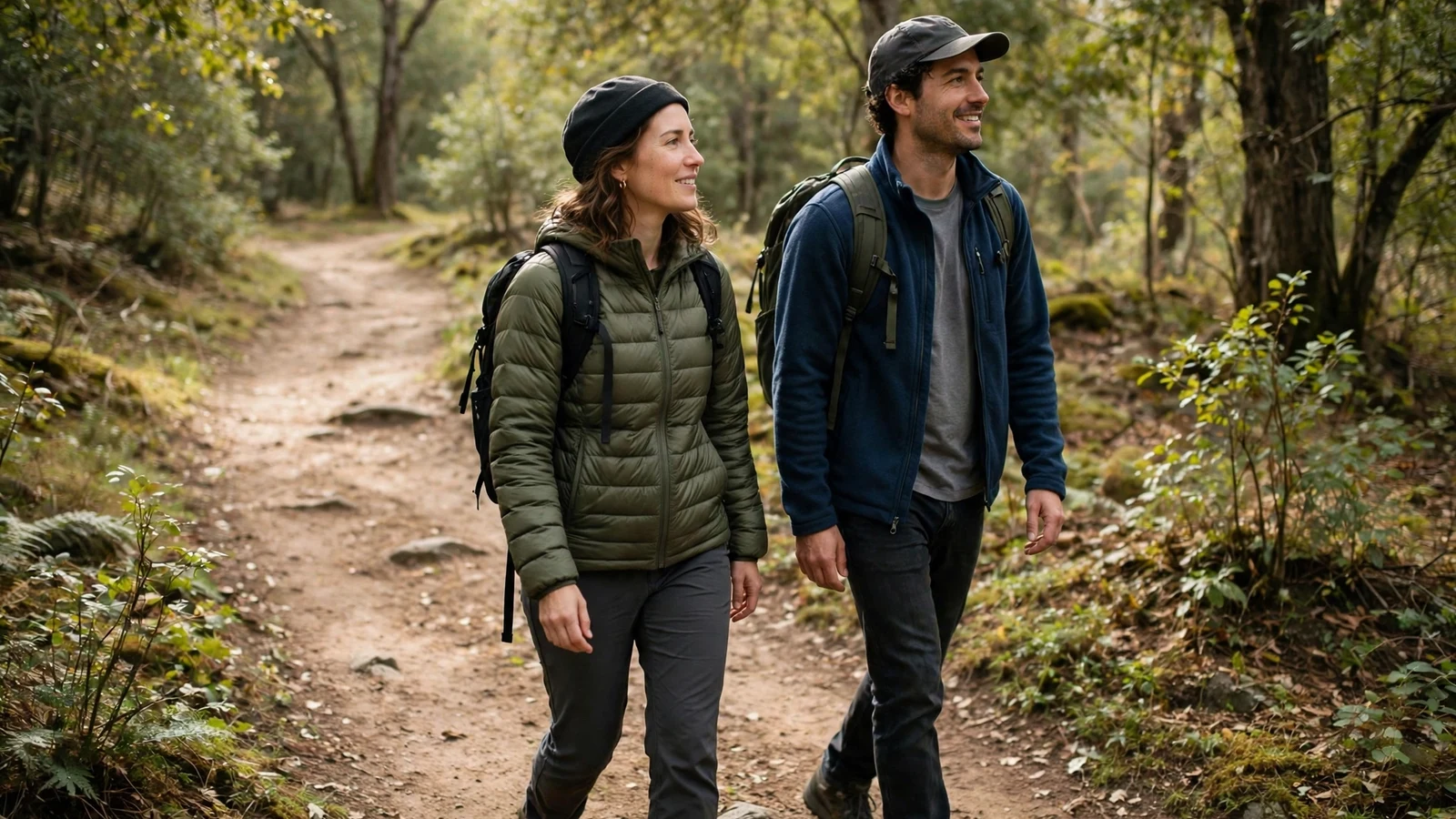
Here is how one ordinary day can look. She runs at six, alone, with her thoughts and her playlist. He lifts at six in the evening, alone, with his radio. At seven-thirty, after dinner, they walk around the block together, twenty minutes, no phones, no pace goals. The walk is not exercise. It is the part of the day where the two separate workouts meet, and where the couple catches up on everything the day held.
The shared walk works because it asks nothing of fitness. Nobody is faster. Nobody is stronger. Nobody is waiting or being waited for. A walk lets two people move at the speed of conversation, which is the speed that matters for a marriage. It also gives the day a soft ending, a tiny ways to say i love you kind of gesture that costs nothing and says, I still want your company at the end of the day.
Keep the walk short enough that it survives bad weather and tired evenings. Twenty minutes is plenty. If rain cancels it, move it inside: walk the mall, walk the hallway, or just stand in the kitchen and talk for twenty minutes with tea. The point is the together time, not the steps. A walk that only happens in perfect weather is a walk that happens twice a year.
Some couples add a second shared moment on weekends: a slow Saturday hike, a bike ride at a gentle pace, a swim where lanes do not matter. Weekend movement can be shared precisely because it is not a workout. It is an outing, and outings forgive different speeds in a way training sessions do not.
The check-in that replaces the shared gym

If you no longer share a workout, you need something else that says, I care about how your body and your day went. That something is a short daily check-in, and it works best when it asks about feeling, not performance. Not “how far did you run” or “how much did you lift.” Those questions turn a spouse into a coach. Ask instead, “How did it feel today?”
Try these exact words after your spouse’s workout: “How did it feel today, good tired or bad tired?” That question does two things at once. It shows you noticed they moved, and it invites an honest answer instead of a number. Good tired means the workout helped. Bad tired means something hurt, or the day was too much, and your spouse might need rest instead of praise. Either answer opens a real conversation, which is more than a shared gym ever gave you.
The check-in also needs one boundary: no fixing unless asked. If she says her knee ached on mile three, the helpful reply is, “That sounds rough, do you want company on a walk tomorrow instead?” The unhelpful reply is a lecture about shoes, form, or stretching. She did not ask for a coach. She asked, by telling you, for a witness. Be the witness first, and only offer advice if she asks for it directly.
Make the check-in part of a moment that already exists. Ask it during the shared walk, or over dinner, or while you are both getting ready for bed. A check-in that needs its own appointment will not survive a busy week. A check-in tucked inside the evening walk becomes as automatic as the walk itself, and an evening ritual for couples can hold both habits steady when weeks get hectic.
One last piece of the check-in: celebrate the streak, not the stats. “Three weeks of morning runs, I am proud of you” lands better than “you are two minutes faster than last month.” Streaks honor effort, which is the part your spouse controls. Stats honor numbers, which is the part that eventually stalls, and stalled numbers make people quit. Praise the showing up, and the showing up keeps happening.
Frequently asked questions
Is it bad for a marriage if we never work out together?
No. A marriage is not measured by shared workouts. It is measured by shared care, and care can live in a walk, a question, and a habit of noticing. Plenty of close couples never train together, and plenty of couples who train together still feel distant. The workout is not the bond. The attention is.
What if one of us wants to share a workout and the other does not?
Compromise on the edges, not the core. Keep your own workouts, and add one shared outing a week that is not training: a walk, a gentle bike ride, a swim. That gives the partner who wants togetherness a real shared moment, without asking the other partner to give up the workout they love.
How do we handle it when one person’s fitness habit changes?
Talk about it the way you would talk about any change in routine: plainly, and early. If she stops running, ask how she feels about it before you suggest a replacement. If he starts training for something big, agree on how the extra hours fit around family time. Habits change, and a marriage bends around those changes best when nobody pretends they did not happen.
So, do you and your spouse move together, apart, or a little of both, and what small shared moment holds it together for you? Tell us in the comments: the walk, the question, or the ritual you would not give up. Another couple might borrow your rhythm this week and stop forcing a workout that never fit either of them.
Keep Reading
If this hit home, these might too:
Going through something similar?
Share your experience anonymously with the Ever After Daily community. Every story is read by a human editor before anything is published.
Share Your Story