Making Friends as a Couple in a New Town
Moving somewhere new is lonelier for couples than anyone admits. Three places to meet people, and how to invite someone over so a hello becomes a friendship.

Making Friends as a Couple in a New Town
We moved to a new city on a Saturday in March, and by the following Friday we had unpacked every box, hung the curtains, learned which grocery store was closest, and realized we did not know a single person within a hundred miles. The apartment looked like home. It did not feel like home, because home is not a place with your furniture in it. Home is a place with your people in it, and our people were all far away.
That first month was the loneliest either of us had felt in years, and the strange part was that we were not alone. We had each other. We ate dinner together every night, we watched shows together, we went for walks together. And still, something was missing, because a marriage is not a whole social life. Two people, no matter how much they love each other, cannot be each other’s only company. We needed friends, and we needed them as a couple, people we could invite over and be invited by, people who knew us both.
If you have just moved, or you are about to, this is the honest truth about it: making friends as a couple in a new town is harder than making friends on your own, and it is lonelier than it looks from the outside, because everyone assumes a married couple is fine. You are not fine. You are two people starting from zero, and starting from zero takes a plan.
Why moving as a couple feels lonelier than it looks

When you move somewhere new as a single person, the world expects you to be looking for people. Coworkers invite you to lunch. Neighbors introduce themselves. You join things, because joining things is what single people in a new town do. When you move as a couple, the world assumes you brought your social life with you. Nobody rushes to adopt a married couple, because a married couple looks complete from the outside. The completeness is an illusion, but it is a convincing one.
There is also a quieter problem inside the move itself. You and your spouse become each other’s entire world by default, because there is nobody else around yet. That sounds romantic for about two weeks. Then it starts to wear thin. You run out of new things to say to each other, because you are both having the same day, in the same new place, with the same two people in it. You start to lean on each other for everything, company, conversation, comfort, entertainment, and no one person can carry all of that. The marriage starts to feel heavy, not because anything is wrong with it, but because it is doing the work of a whole community all by itself.
And there is the fear that nobody talks about. It is embarrassing to need friends as an adult. It feels like something you were supposed to have sorted out by now, like you missed a step somewhere. So couples in a new town often wait. They wait for friends to appear, for a neighbor to knock, for a coworker to invite them over. Waiting feels safer than trying. But waiting is also how a year goes by with no one to call.
The fix is not complicated, but it does ask something of you. You have to be the ones who go first. You have to be the couple that says hello first, invites first, and shows up first. That feels awkward for about a month, and then it starts to feel like your life.
Three places to meet people
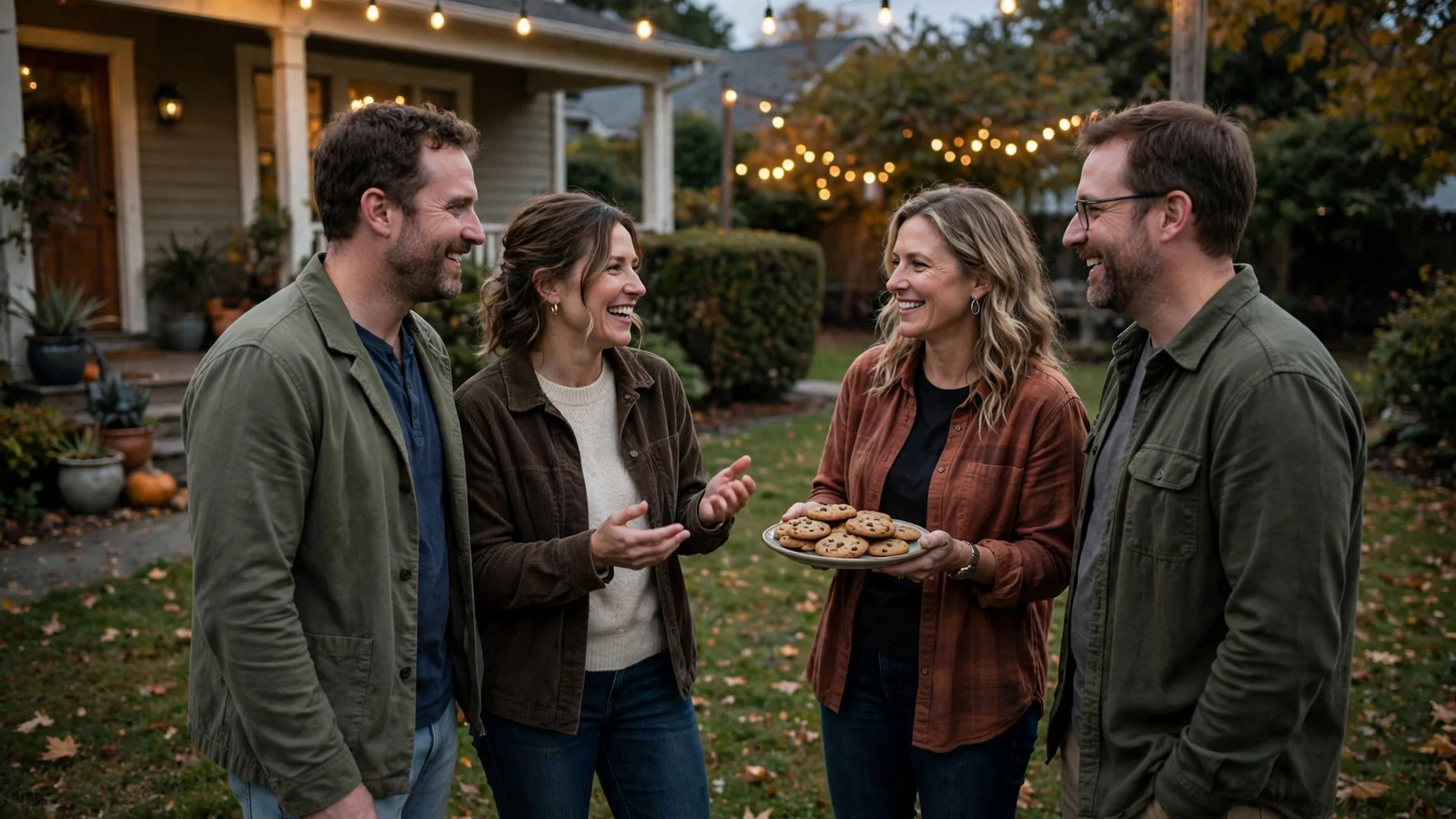

You do not need a dozen strategies. You need three places, and you need to show up at all three, regularly, for a couple of months. Regularity is what turns strangers into familiar faces, and familiar faces into friends.
The first place is something weekly with a fixed time and the same faces. A class, a club, a volunteer shift, a church group, a sports league, anything that meets every week whether you feel like going or not. The fixed time matters more than the activity, because a fixed time is how people learn to expect you, and expectation is the beginning of belonging. A book club that meets on the first Tuesday, a Saturday morning hiking group, a cooking class on Thursday nights, any of these will do. Pick one together, the way you would pick a club you both enjoy, and commit to it for three months before you judge it.
The second place is your own neighborhood. Not the whole town, just your street, your building, your block. Neighbors are the easiest friends to make and the easiest to keep, because you live next to each other and you keep running into each other. Learn names. Wave first. Bring cookies to the new neighbors, even if you are the new neighbors. Ask who has a good plumber, who knows a decent pizza place, whose dog is the one barking at six in the morning. Small talk with neighbors sounds trivial, but it is the raw material of friendship, and it costs you nothing but a little courage.
The third place is something that belongs to just one of you, but that you both support. A work friendship, a gym class, a hobby group, a parent group at the school gate. One of you goes, makes a friend, and brings that friend home to meet the other one. This is how most couple friendships actually start, not as a pair meeting another pair, but as one person meeting one person and then the circles overlapping. It also keeps the pressure off, because neither of you has to be charming on demand in front of strangers. One of you makes the first connection, and the other one joins in when it feels natural.
Three places, every week, for a couple of months. That is the whole plan. It sounds simple because it is simple. The hard part is not the plan. The hard part is doing it when it feels awkward, and doing it again the next week when the awkwardness has not quite gone away yet.
Making the first invitation

Meeting people is only half the job. The other half is the invitation, and the invitation is where most new-town couples stall. You have had three nice conversations with a couple from the hiking group, you like them, they seem to like you, and then you both go home, and nothing happens, because nobody said the words that turn a friendly chat into a friendship.
So here are the words. Say them exactly like this, the next time the moment is right: “We have really enjoyed talking with you. Would you two want to come over for dinner on Saturday? Nothing fancy, just pasta and whatever we have in the fridge.” That is the whole script. It names the pleasure you took in their company, it names a specific day, and it lowers the stakes by promising nothing fancy. Most people say yes to that invitation, because most people in a new town are also waiting for someone to invite them first.
If dinner feels like too much, start smaller. Coffee after the hiking group. A walk with the dogs. A drink on a Friday after work. The size of the invitation matters less than the fact that it happened, and that it had a time attached to it. “We should get together sometime” is not an invitation. “Saturday at six” is an invitation, and Saturday at six is how friendships start.
Say yes when you are invited, too, even when you are tired, even when the house is a mess, even when you would rather stay in. The first year in a new town is not the year to be picky about invitations. Say yes to the barbecue, yes to the game night, yes to the neighbor’s birthday drinks. You can be picky later, once you have people to be picky among. In the beginning, yes is the whole strategy.
And when the first invitation works, do it again, quickly. Invite them back within two weeks, before the warmth cools off. Friendship grows on repetition, and the second time is easier than the first, because now you are not strangers anymore. You are the couple who makes good pasta, and they are the couple who brought the wine, and that is a perfectly good foundation for a friendship.
A shared circle changes a marriage, too. It gives you stories to bring home that did not happen inside your own four walls, and reconnecting with your spouse emotionally is built out of exactly that kind of fresh material. It also takes the pressure off the marriage to be everything, which is the kindest thing you can do for it. Bring this plan to the weekly marriage check-in and pick your three places together, so it is a decision you both made, not a chore one of you carries alone.
Frequently asked questions
How long does it take to make real friends in a new town?
Longer than a month, shorter than a year, for most couples who show up regularly. The first familiar faces come in a few weeks. The first real friendship, the kind where someone calls you just to talk, usually takes a few months of steady showing up. The couples who make friends fastest are not the most outgoing. They are the most consistent.
What if my spouse is shy and hates meeting strangers?
Let the shy one set the pace, and let the outgoing one go first. One of you can do the approaching while the other one joins the conversation once it is going. Shy people make wonderful friends once they are past the first hello, and the first hello is the only part that needs courage. Small settings help too: a dinner with one other couple is easier than a party with twenty strangers.
What if we try for months and still have no close friends?
Look at the pattern before you blame yourselves. Are you actually showing up every week, or did you drift after the first month? Did you make the first invitation, or are you still waiting for one? If you have truly shown up and invited and still feel stuck, try a different place, because some groups are closed and it is not your fault. The right group is out there, and the only way to miss it is to stop looking.
So, if you moved somewhere new, what is your plan, and which of the three places will you try first? Tell us in the comments, if you are willing. Your answer might be the push another couple needs to stop waiting and go first.
Going through something similar?
Share your experience anonymously with the Ever After Daily community. Every story is read by a human editor before anything is published.
Share Your Story