
A Morning Goodbye Ritual for Busy Couples
Rushed mornings can leave a couple feeling distant all day. One short goodbye ritual, with eye contact and one real sentence, can change how the day starts.

A Morning Goodbye Ritual for Busy Couples
The alarm goes off at 6:10, and the next thirty minutes belong to everyone except the two of you. One of you packs lunches while the other hunts for a clean shirt. The dog needs out, a child needs a permission slip signed, and the coffee maker gurgles in the background like a third person demanding attention. Then one of you grabs a bag, calls out “Bye, love you” toward the hallway, and the front door closes. The other one stands in the kitchen, holding a mug, and feels oddly alone in a house that was full a minute ago.
Nothing went wrong in that morning. That is the problem. No one fought, no one said anything unkind, and still the goodbye felt empty. A rushed goodbye does not hurt because of what it says. It hurts because of what it skips: a moment of eye contact, one sentence that actually lands, and proof that you noticed each other before the day pulled you apart.
A morning goodbye ritual does not need to be long, sweet in a staged way, or the same every day. It needs to be real, and it needs to survive a morning when the toast burns and the car needs gas. The rituals below are built for that kind of morning.
What rushed goodbyes miss

A rushed goodbye misses two things, and both of them matter more than the words “love you” on their own.
The first is eye contact. When you say goodbye while looking at your phone, your bag, or the door, your spouse hears the words but does not feel seen. Eye contact takes two seconds, and it changes a routine line into a real exchange. It says you paused for this person, on purpose, before you left. Without it, the goodbye can feel like a task checked off a list, and tasks do not carry warmth into a long day.
The second is one real sentence. “Have a good day” is kind, but it fits every day and therefore fits no day in particular. A real sentence names something true about today: “Good luck with that meeting at ten.” “I hope your mom’s appointment goes well.” “Text me when you get through the traffic on the freeway.” That kind of sentence tells your spouse you were listening last night, and you remembered. It turns a generic send-off into evidence that you know each other’s lives.
When both pieces go missing for weeks, the distance builds quietly. Neither spouse can point to a fight or a single bad morning. They can only say the mornings feel lonely, and the days feel longer. A small ritual fixes that gap at the source, before the day starts, instead of trying to repair it at dinner when you are both tired.
If your evenings also feel rushed, a calmer evening ritual for couples can give the day a softer landing to match the better start.
Ritual one: the door pause

The door pause is the simplest ritual on this list, and it works because it has one rule: stop at the door.
Before the first person leaves, both of you stop where you are, face each other, and take about ten seconds. No phones, no bags being adjusted, no calling out from another room. Look at each other, say one real sentence about the day ahead, and give a kiss or a hug that lasts longer than a peck on the cheek while moving.
Here is what that can sound like on an ordinary Tuesday: “You have that big presentation at eleven, right? You have got this. Text me after.” That is it. No speech, no big gesture. The power is in the pause itself, because the pause says this person matters more than the schedule for ten seconds.
The door pause survives busy mornings because it asks for almost nothing. It does not need a quiet house or a slow morning. It needs two people willing to stand still for ten seconds. On mornings when even that feels hard, shrink it further: eye contact, one sentence, and a hand squeeze at the door. A small version done every day beats a grand version done once a month.
Ritual two: the text after
Some mornings will not allow a door pause. One of you leaves before the other wakes up, or the kids turn the kitchen into chaos right at departure time. That is where the text after comes in.
The text after is a short message sent within the first hour after leaving, and it finishes the goodbye that the morning cut short. It is not a check-in about errands, and it is not a reply to a bill reminder. It is one line that belongs only to your marriage: “Thinking of you on that drive.” “You handled this morning like a champ.” “Still laughing about what you said over coffee.”
The timing matters. A message at 7:30 lands differently from a message at noon, because at 7:30 your spouse is still carrying the morning. The early text says the goodbye did not end at the door, and the day started with you still in mind. It also gives the spouse at home something warm to carry into their own morning, whether that morning means an office, a classroom, or a sink full of breakfast dishes.
Keep the text short and specific. A long message can feel like one more thing to answer, and the point is connection, not correspondence. One line, sent early, does the job. If you both like the habit, it can become a quiet thread of its own, separate from the practical texts about groceries and pickup times.
Ritual three: the coffee handoff

The coffee handoff turns a chore you already do into a ritual, and it suits couples who share a kitchen in the morning but barely talk in it.
One person makes the coffee, and the other receives it with a moment of attention. The person handing over the mug says something true about the day, and the person receiving it stops, takes the mug with both hands, and answers. The exchange takes twenty seconds, and it happens before either of you leaves the kitchen.
A coffee handoff might sound like this: “Here, yours is the one with extra milk. You were up late finishing that report, so I made it strong.” The spouse takes the mug and says, “Thank you. I needed that, and I needed you to notice.” Nobody staged that exchange. It grew out of a real morning, a real late night, and a real mug of coffee. That is why it works, and why it keeps working after the novelty wears off.
This ritual pairs well with a shared morning coffee ritual for couples, which covers how couples can protect a few unhurried minutes together before the day takes over.
If coffee is not your drink, the handoff still works. Tea, a smoothie, a packed lunch handed over with a sentence about the day, all of them count. The drink is not the ritual. The handoff, with attention, is the ritual.
When mornings do not match
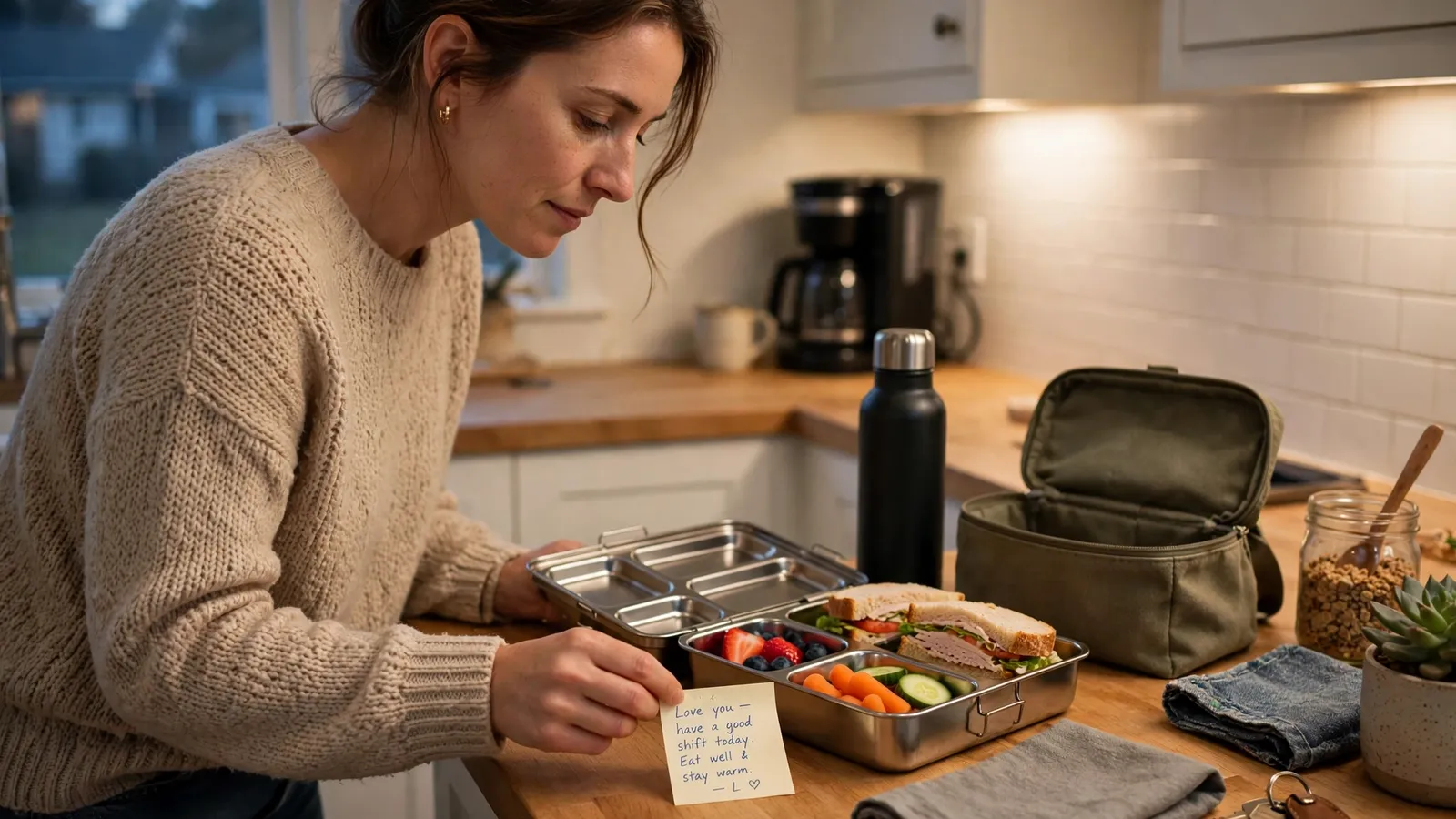
Not every couple shares a morning. Shift work, early school runs, and different jobs can mean one spouse leaves at 5:30 while the other sleeps until seven. Kids add their own schedule, and a ritual that needs both people awake at the same time will fail on those mornings through no fault of either spouse.
For shift-work couples, pick the overlap, not the ideal. If one spouse comes home as the other leaves, the goodbye and the hello can share one moment at the door: ten seconds, eye contact, and one real sentence before the day shift starts and the night shift ends. If there is no overlap at all, the text after becomes the main ritual, and a note on the counter can stand in for the door pause. A short note that says “Good luck today, I left your lunch in the fridge” carries the same care as a spoken sentence, and it waits patiently until the other person wakes up.
For couples with kids, protect the ritual by keeping it small and letting the kids see it. Children do not need a private ceremony. They benefit from watching their parents pause, look at each other, and say something kind before the day starts. Keep it brief so the school run stays on track, and do not let the ritual become one more job on a morning list. If the kids are melting down, the ritual shrinks to eye contact and a hand squeeze, and that counts as done.
The test of a good ritual is not whether it looks perfect. The test is whether it still happens on a bad morning. Pick the version that fits your real schedule, and let it bend on the days when the schedule wins. A bent ritual that still happens beats a perfect ritual that quietly disappears.
So, what does your goodbye look like on a normal Tuesday, not a holiday morning but a real one with lunches and traffic and tired eyes? Try one of these rituals for a week, and notice what changes in the hours after the door closes. Then tell each other what you noticed, because that conversation is part of the ritual too, and it is how a small habit grows into something your marriage can count on.
Frequently asked questions
What is a good morning goodbye ritual for couples?
A good ritual has three parts: stop, look at each other, and say one real sentence about the day ahead. The door pause, the text after, and the coffee handoff all work because they are short, specific, and easy to repeat on busy mornings.
How long should a morning goodbye ritual take?
Ten to thirty seconds is enough. A longer ritual sounds nice, but it will not survive a morning with a late alarm, a sick child, or traffic. Pick a version you can do on your worst morning, and skip the version that only works when everything goes right.
What if my spouse leaves before I wake up?
Use the text after as your main ritual, and add a note on the counter when you can. The goodbye does not have to happen face to face to count, as long as it carries one real sentence and arrives early in the other person’s day.
Keep Reading
If this hit home, these might too:
Going through something similar?
Share your experience anonymously with the Ever After Daily community. Every story is read by a human editor before anything is published.
Share Your Story


