
The Sunday Mornings That Belong to Us Again
After years of kids’ Sunday schedules, the morning is ours again. Coffee, the paper, nowhere to be, and the one small rule that keeps Sunday morning ours.

The Sunday Mornings That Belong to Us Again
Sunday used to start with an alarm. Not the gentle kind. The kind that went off at seven while it was still dark, and one of us would reach across the bed and hit it, and the other would already be up, moving through the house, turning on lights, packing lunches, finding the missing shoe. The kids had practice at nine and homework that had waited until Sunday morning and a science project that needed poster board we did not have. We ate breakfast standing up. We drove in two cars. We met back at the house at noon, tired, and the day was half gone before we had said more than ten words to each other. That was Sunday for twenty years. That was normal. That was the deal, and we loved the kids, and we did not mind the deal, but the deal is over now, and Sunday is ours again.
The first slow Sunday caught us by surprise. We woke up at eight, which felt late, and the house was quiet, and nobody needed a ride anywhere. He made coffee. I sat at the kitchen table with the paper, which I had not read on a Sunday in years, and the coffee was hot, and the house was warm, and there was nowhere to be. We sat there for an hour. We did not do anything worth writing down. We talked about the garden. We talked about a movie we might watch that night. We talked about nothing, really, and it was the best Sunday we had had in years. That was the morning we learned something we should have known all along: a slow Sunday is not an empty Sunday. It is a full one, just full of different things.
The old Sundays
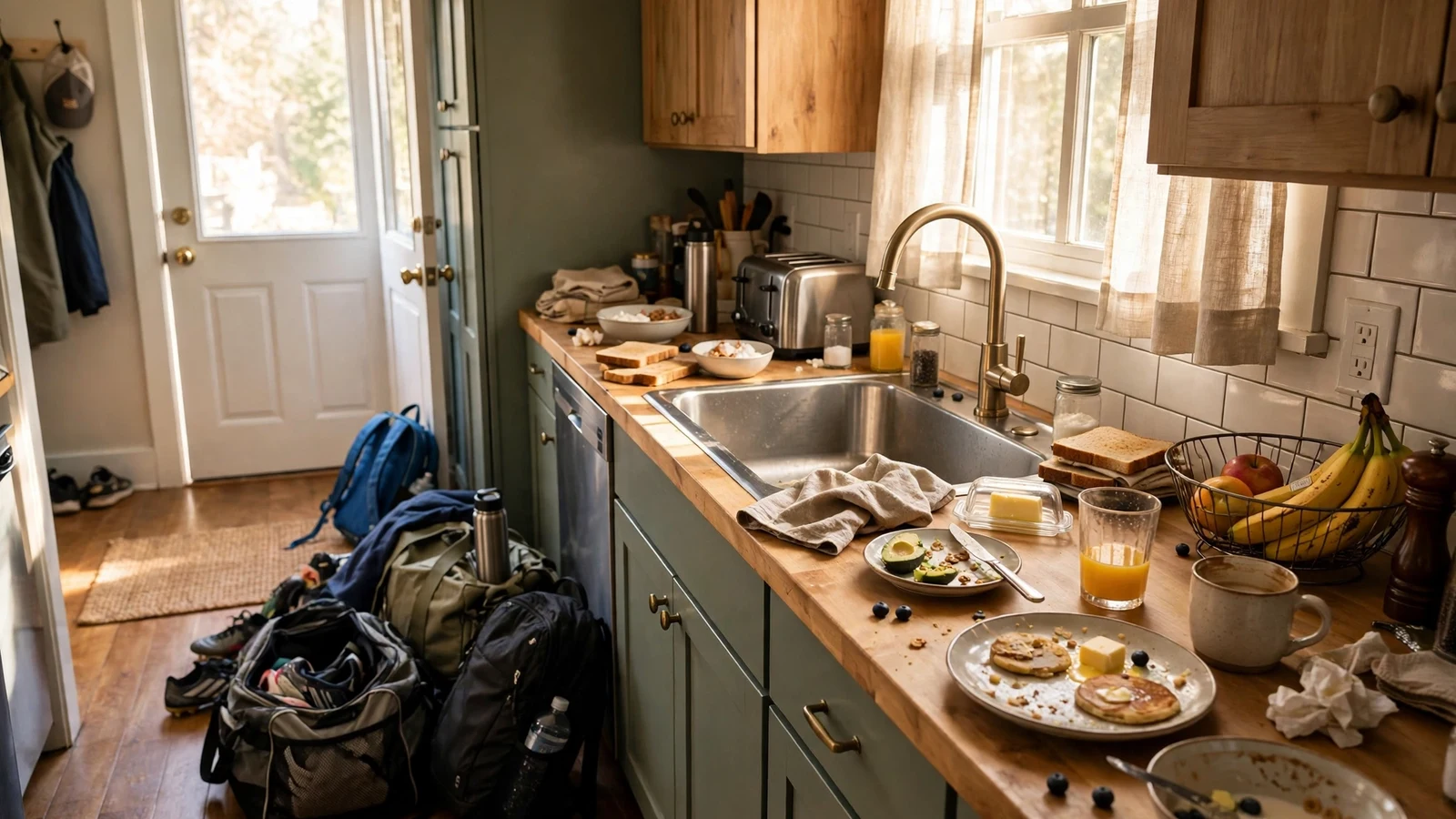
The old Sundays ran on a schedule we did not write. The kids wrote it, with their practices and their games and their homework and their friends, and we ran it because that is what parents do. Saturday was for the house and the shopping. Sunday was for the kids. We got up early, we drove, we waited on bleachers, we came home, we cooked, we helped with the homework, we fell asleep on the couch with the television on. On Monday morning we would look at each other across the kitchen and say, “Did we even have a weekend?” We laughed about it, because that is what you do, but the laugh was tired.
The rush had a shape, and the shape was the same every week. The kitchen in the morning, with two kids eating different breakfasts at different speeds. The car keys on the counter. The bag by the door. The drive to the field, the drive to the library, the drive home. The afternoon, with the homework spread across the dining table and the printer out of ink again. The evening, with the lunches packed and the backpacks by the door and the house finally quiet, except it was nine o’clock and we were already half asleep. Sunday was a workday in a different shirt. We did not know it at the time, because we were inside it, but looking back, the thing we missed most was not sleep. It was each other. We spent the whole day in the same house and the same car, and we barely spoke, because there was always a next thing to do.
If your Sundays still look like that, hold on. The rush ends. It ends faster than you think, and one Sunday you will wake up and the house will be quiet and the calendar will be blank, and you will not know what to do with it at first. That is normal. A blank Sunday feels strange after twenty years of full ones. Give it a few weeks. The quiet grows on you.
The first slow Sunday
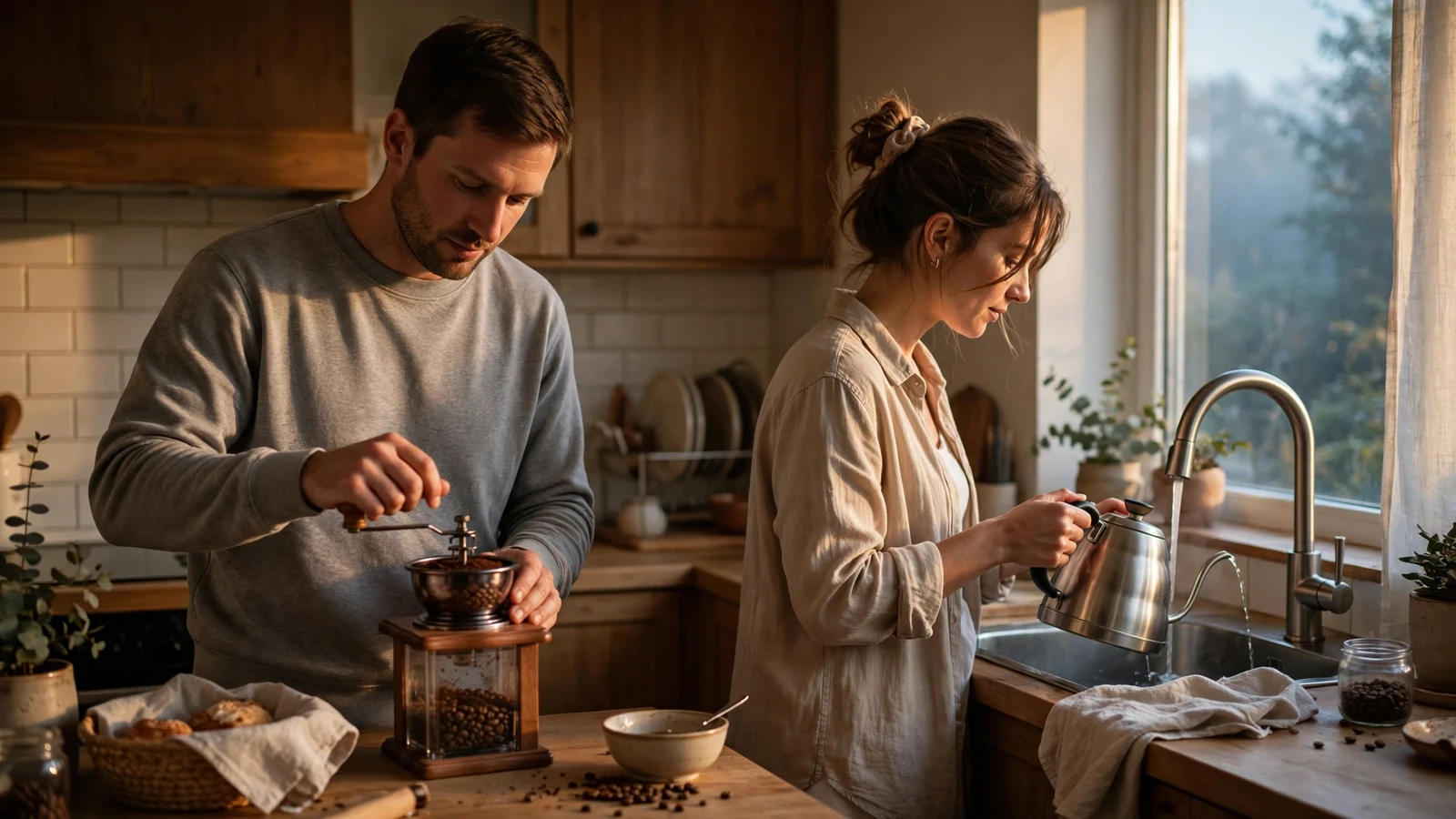

Our first slow Sunday started the way all the good ones do now: with coffee, made slowly, in the kitchen, while the house was still dark. He grinds the beans. I fill the kettle. We have done it so many times now that we do not need to talk about it, and the quiet in the kitchen at seven in the morning is the good kind, the kind that comes before the day starts. We take the mugs to the table by the window, and we sit, and we do not rush. The paper is there. The toast is there. The morning is there, and it is ours, and nobody is going to take it away with a practice schedule.
The rule of a slow Sunday is that nothing on it is required. The garden can wait. The laundry can wait. The phone can wait. The only things on the schedule are the ones we choose, and we choose small ones: a walk after breakfast, a chapter of a book, a phone call to one of the kids, a nap on the couch with the dog. The morning stretches out in front of us like a road with no traffic, and we take our time on it, because there is no reason not to. Some Sundays we stay at the table until ten. Some Sundays we are out the door by nine, walking the long way around the neighborhood, holding hands the way we did when we were young and had nowhere to be either.
The coffee matters. Not the brand, not the machine, just the fact that we make it together and drink it sitting down, in the same place, at the same time, every Sunday. A ritual is a small thing done the same way, on purpose, and the coffee is ours. He grinds, I pour, we sit. It takes ten minutes. It sets the tone for the next three hours.
Do not fill the first slow Sunday with plans. That is the mistake we made the second week, when we decided to use the free morning to clean out the garage. The garage got cleaned, and the Sunday got lost, and we sat at dinner that night and looked at each other and said, “We just did it again.” A slow Sunday is not a free morning to get things done. It is a morning to be together, on purpose, doing nothing that has to be done. The garage will be there next Saturday. The Sunday will not come back.
The rule that protects it

Every good thing in a marriage needs a rule to protect it, and our Sunday has one. The rule is simple: nothing gets scheduled on Sunday morning before eleven. No errands, no visits, no calls that can wait, no work that can be done on Monday. Eleven o’clock is the fence. Inside the fence, the morning is ours. Outside the fence, the day can be whatever it needs to be.
The rule sounds easy, and it is not. The world will try to take Sunday morning from you, politely, one small request at a time. A neighbor will ask for help moving a couch. A kid will call and ask you to come over for brunch. A store will have a sale that ends at noon. Each request is small, and each one feels reasonable, and if you say yes to all of them, the Sunday is gone by ten o’clock and you are standing in a parking lot wondering where the morning went. The rule gives you a sentence to say. “Sunday morning is ours. Can we do it after eleven?” Most people understand. The ones who do not understand will understand next week, when you say the same thing again.
We wrote the rule down, the way we write down the things that matter. It is on the fridge, on a small card, in his handwriting: “Sunday before 11: ours.” It has been there for two years. The card is bent at the corner and the ink has faded, but the rule has not. Some weeks we break it, because life happens, because a grandchild is sick or a friend needs a ride, and that is fine. A rule you break once in a while is still a rule. A rule you never made is just a wish, and wishes do not survive a phone call.
Protect the morning, and the morning will protect the marriage. That sounds like a big claim for a pot of coffee and a newspaper, but it is true in our house. Sunday morning is the one part of the week when we are not parents, not grandparents, not neighbors, not anyone’s ride. We are just the two of us, at a table, with coffee, talking about the garden and the movie and nothing at all. Twenty years from now, when someone asks us what kept us close, I think we will say the Sundays. Not the trips, not the big days, just the Sundays, one quiet morning at a time. An evening ritual does the same work at the other end of the day, and the first week in the quiet house is when most couples find their Sunday again.
Frequently asked questions
What if our Sundays are still full of kids’ activities?
Then wait, and do not rush it. The full Sundays end sooner than you think. In the meantime, steal twenty minutes: coffee together before the first practice, no phones, no schedule talk. Twenty minutes is not a whole morning, but it is a start, and it teaches you both what a slow Sunday feels like.
What if one of us likes to sleep in and the other likes to get up early?
Let the early one have the kitchen and the coffee, and let the late one have the bed. The rule is not that you wake up together. The rule is that the morning belongs to both of you, in whatever shape fits. Meet at the table when the second one is up, and start there.
What if we try a slow Sunday and it feels boring?
Give it three weeks. The first slow Sunday feels strange because you are used to a schedule telling you what to do. Boredom is often just quiet you have not learned to enjoy yet. If it still feels flat after three weeks, add one small thing you both like: a walk, a bakery, a drive. The morning does not have to be empty. It has to be yours.
What does your Sunday morning look like now, and what would you do with it if it were yours again? Tell us in the comments, if you are willing. Your answer might be the Sunday another couple has been waiting to try.
Going through something similar?
Share your experience anonymously with the Ever After Daily community. Every story is read by a human editor before anything is published.
Share Your Story


