My Spouse Checks My Phone Every Night: What That’s Really About
Your spouse checks your phone nightly and you’re not sure what to do. Why it happens, boundaries that help both sides, and when it becomes a red flag.
My Spouse Checks My Phone Every Night: What That’s Really About
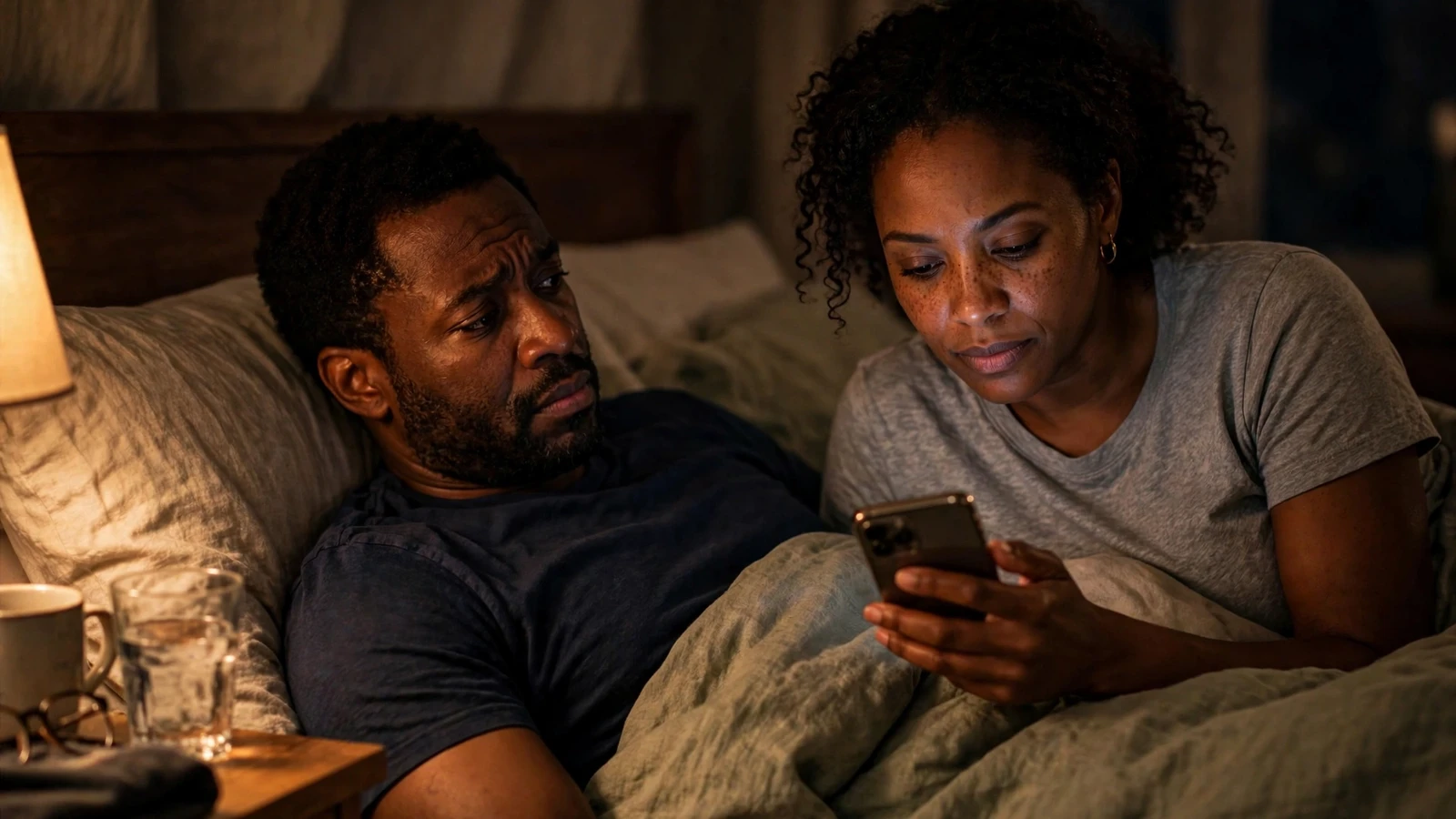
The moment lands the same way every night. Teeth brushed, lights low, the house finally quiet — and your phone lights up the ceiling from your spouse’s hands.
Sometimes it’s quick, a thumb flick through notifications. Sometimes it’s slower. Messages opened. Photos scrolled. Search history checked with the concentration of someone reading a contract they didn’t sign.
You lie there doing a mental inventory: Is there anything on there that could be read wrong? Did I delete that thread? Why do I feel guilty when I haven’t done anything? And then, layered under the irritation, the question that brought you here: What is this really about — and how do I live with it without losing myself?
This article is for the partner being checked. That’s a different chair than the one in why you check partner’s phone, which sits with the urge to look. Here, we’ll sit with what it feels like to be looked through, what nightly checking usually signals, and where the line sits between a rough trust season and a pattern that harms you both.
What Nightly Phone Checking Usually Signals

A nightly check is rarely just about the phone.
Phones hold the unedited version of a life — the venting text to a friend, the dumb meme at 1 a.m., the work thread that bled into dinner. For a spouse who feels unsteady, that glowing rectangle can start to feel like the one place the whole truth lives. Checking becomes a way to calm the spiral: If I look and find nothing, I can sleep.
That doesn’t make it harmless. Reassurance that has to be renewed every night isn’t really reassurance. It’s a ritual, and rituals need a reason to exist. Underneath nightly checking, couples usually find one of these:
Anxious attachment after a hurt. Something happened — a secret, a lie, a boundary that blurred — and sleep has become the hardest time to trust a quiet house. Many couples in this spot are living inside the longer repair described in rebuild trust after lying, where proof matters more than promises for a while.
A bid for closeness that missed its language. Your spouse may not actually suspect an affair. They may feel shut out of your inner life and reach for the most detailed map of it they can find. It is still a problem to solve with words, not with a passcode.
Control dressed up as worry. If the checking comes with rules about who you can text, accusations built from innocent threads, or punishment when you ask for privacy, you’re in different territory. That’s not anxiety looking for comfort. That’s monitoring, and we’ll talk about it directly below.
Habit that outgrew the crisis. Sometimes a temporary transparency agreement after a rupture never got an end date. What started as “show me until I can breathe again” became the permanent bedtime routine. Nobody chose that on purpose. It just never got revisited.
None of these explanations require you to hand over your inner life without limits. Understanding the signal helps you respond to the real problem instead of spending every night defending a home screen.
The Difference Between Transparency and Surveillance

Healthy transparency during a repair season has three features: it’s mutual in spirit, it’s time-bound, and its purpose is to rebuild safety — not to win arguments.
It might sound like this in a real house: “For the next two months, phones stay open on the counter. Either of us can ask to see anything, and the other person hands it over without a speech. We check in at the end of the month about whether it still needs to be this open.” Both people know why it’s happening, what it covers, and when you’ll talk about loosening it.
Surveillance feels different in the body. It’s one-sided, open-ended, and its purpose quietly shifts to catching. The checked partner starts rehearsing before they come home: deleting a funny but flirty-sounding joke from a friend, cropping a story so it can’t be misread, choosing not to text a sibling about a rough night because explaining the thread later feels exhausting.
That rehearsal is the cost. When you begin editing your friendships, your humor, and your private processing to survive a nightly review, the checking is no longer protecting trust. It’s shrinking the life trust is supposed to protect.
If you’re trying to picture what steadier safety feels like when it isn’t built on inspection, what emotional trust looks like describes the boring, repeatable behaviors that tend to lower the temperature in a house. And if you want language for the felt sense underneath it, signs spouse feels emotionally safe names what partners notice when safety starts returning.
Boundaries That Help Both Sides Feel Steadier

A boundary here isn’t a punishment and it isn’t a locked phone slammed down like a verdict. It’s a shared agreement that protects both the repair and the personhood of the partner being checked.
Try building yours from these parts:
Name the season and the reason. “Since February, trust has been shaky because of the messages I hid. I get why you want openness right now.” Naming it out loud keeps the checking attached to a real story instead of floating free as a permanent right.
Agree on what “open” actually covers. Can either of you read full message threads, or is the agreement that phones aren’t hidden, passwords are known, and questions get honest answers? Those are different levels of exposure. Pick the one that matches the size of the hurt, not the size of the fear at midnight.
Put an end date on the calendar, even a soft one. “Let’s try this until June 1, then talk about what’s still needed.” An end date doesn’t promise the anxiety will be gone. It promises the arrangement will be chosen again on purpose instead of hardening into law.
Protect one small private space each. A journal. A therapy note. A conversation with a sibling about a surprise party. Naming a protected space keeps transparency from turning into total access, and total access is where resentment grows fastest.
Decide how questions get asked. Honest answers land better when the question isn’t an ambush. Many couples do better with: “I saw a thread that confused me. Can we look at it together after dinner?” instead of a 1 a.m. cross-examination in the dark.
If apologizing is part of your side of this — for a secret, for getting defensive, for a promise you broke last month — how to apologize after a fight walks through what a repair apology sounds like when it isn’t begging or performing. Transparency asked for honestly deserves honesty offered cleanly, too.
Exact Words to Say (For the Nights It Feels Too Big)
You don’t need a perfect speech. You need a few steady sentences you can reach for when you’re tired and your chest is tight.
When you’re handing the phone over but want the ritual to change: “I’ll show you. I want you to sleep tonight. Can we also talk tomorrow about how we get from checking every night to trusting most nights? I love you, and I don’t want this to be forever.”
When the checking spikes after a calm stretch: “I notice the hard nights are back. Did something happen today that I don’t know about, or is this the old worry visiting? Tell me which one so I can meet the real thing.”
When you need a boundary and you’re afraid it will sound like guilt: “Needing one part of my phone to stay mine isn’t me hiding a life from you. It’s me keeping a self inside this marriage. Here’s what I can offer instead: I’ll tell you who I’m talking to, I’ll keep the phone on the counter, and I’ll answer real questions honestly. I need the nightly full read-through to have an end date, though.”
When you’ve been editing yourself to stay safe: “I caught myself not texting my friend back because I didn’t want to explain the joke tonight. I don’t want to live edited like that, and I don’t think you want a spouse who’s curating instead of living. Can we fix the agreement instead of me fixing my personality around it?”
Notice what none of these lines do: they don’t diagnose your spouse, they don’t deliver an ultimatum at midnight, and they don’t pretend the checking feels fine when it doesn’t. Steady words are honest words, said in a tone you’d use on someone you still plan to build a life with.
When Nightly Checking Is a Red Flag

Most couples who land on this page are in a painful but workable season. Some are not. The difference matters, and it isn’t about how often the phone gets picked up. It’s about what surrounds the picking up.
Treat it as a red flag when:
Your spouse builds cases from innocent material — a coworker’s “thanks!” becomes proof, a friend’s old photo becomes a story — and no amount of context settles it. When evidence can’t land, the issue isn’t information anymore.
Checking comes with rules for your life outside the phone: who you may see, what you may wear to work events, whether you can close a door. Control that spreads beyond the screen is control, full stop.
You feel afraid before you feel annoyed. If your first nightly feeling is dread about what mood the review will create, or if you’ve started hiding entirely normal things (a therapy appointment, a talk with your sister) to avoid a fight, your body is reporting something your mind may be minimizing.
Your spouse refuses any conversation about an end point. “I’ll stop when I feel like it” with anger when you ask how you’ll both know trust is returning is not a repair plan.
There is punishment attached: cold silence for days, threats, taking money or keys, or telling friends and family curated versions of your private threads to win support. That has moved beyond a trust problem.
If several of these feel familiar, private reflection isn’t enough. Talk to a licensed therapist on your own, tell a trusted person what the nights actually look like, and if there is intimidation or fear in your home, reach out to a local support service. You can love someone’s history and still name a present pattern as harmful.
If Trust Was Broken Before the Checking Started
A lot of readers here aren’t in the “nothing ever happened” camp. Something did happen — maybe on your side, maybe years ago, maybe in a gray area you both describe differently. That history changes the conversation, but it doesn’t erase your right to a self.
If you’re the partner who broke trust, openness is usually part of repair for a season, and offering it freely lands very differently than having it taken nightly. Volunteering proof (“Phone’s on the counter, love. Password hasn’t changed. Ask me anything you need tonight”) tells your spouse they won’t have to fight for the truth. That posture matters. It is also finite. Repair that never moves from proof to trust becomes its own kind of distance.
If you’re the partner who was hurt before and now you’re the one being checked by a spouse who also hurt you — yes, that tangle is real, and it’s common. Two people can both owe repair. It still works better when each debt gets named separately instead of being paid in phone reviews.
If the whole truth still hasn’t come out in pieces, no boundary talk will hold for long. New discoveries restart the clock, every time. The couples in can trust come back after infidelity tend to describe the same turning point: the day the last secret surfaced was the day checking slowly stopped being the only way to feel safe.
Maybe that’s not your story. Maybe nothing like an affair happened and the checking grew out of anxiety, a parent’s marriage, a past relationship, or a season of feeling shut out. That story deserves honesty too, and it often gets better fastest when the anxious partner gets support for the anxiety itself instead of a larger nightly data set.
However you landed here, here’s the quiet goal underneath every script in this piece: a marriage where phones are boring again. On the counter. Face-up or face-down without meaning. Charged next to the coffee maker, not evidence in a nightly trial. That ordinariness is what trust actually feels like when it’s working — not thrilling, just steady enough to sleep beside.
So tell me: if the checking stopped tomorrow, what do you think your spouse would still be afraid of — and is that fear something you’ve ever gotten to talk about in daylight? That’s the conversation under this one, and it’s worth having when you’re both rested enough to hear each other.
Frequently Asked Questions
Is it normal for a spouse to check a phone every night?
It’s common during a shaky trust season, especially after a secret or lie has come out. Common and workable aren’t the same thing, though. A short, agreed season of openness is different from an open-ended nightly routine with no plan to revisit it. If it’s every night with no end in sight, treat that as a signal to talk about the agreement itself — not just to endure it.
Should I just hand over my phone to keep the peace?
Handing it over tonight may help everyone sleep, and there’s no shame in choosing calm on a hard night. As a permanent peace strategy, it tends to backfire: the checked partner grows resentful and edited, and the checking partner never gets to practice trusting. Peace that costs you your unedited life isn’t peace. It’s postponement.
What if I have nothing to hide but I still hate being checked?
That reaction makes complete sense. Having nothing to hide and wanting privacy are not opposites. Most adults need a small space where they can vent, joke badly, process a rough day, or plan a surprise without an audience. You can be fully faithful and still ask for a boundary that keeps you a person inside the marriage.
How do we move from nightly checking to actual trust?
Slowly, and mostly through proof in ordinary moments: kept promises, honest answers offered before they’re demanded, phones returning to the counter, and check-ins that happen in daylight. Many couples taper — from nightly, to when a worry actually spikes, to asking with words instead of reading. If the taper keeps collapsing, a therapist can help you build the step-down instead of white-knuckling it.
When should we get counseling about this?
Get support when the checking is nightly for months with no softening, when innocent threads keep turning into accusations, when either of you feels afraid at bedtime, or when you’ve both had the same fight about the phone more times than you can count. Counseling here isn’t about declaring a winner. It’s about giving the trust problem a room where it can be solved without one of you playing detective and the other playing defendant.
Keep Reading
If this hit home, these might too:
- why you check partner's phone
- rebuild trust after lying
- what emotional trust looks like
- signs spouse feels emotionally safe
- how to apologize after a fight
- can trust come back after infidelity
Going through something similar?
Share your experience anonymously with the Ever After Daily community. Every story is read by a human editor before anything is published.
Share Your Story