The Kitchen Table We Refinished Together
Our kitchen table carried ten years of scratches, so we sanded it down one weekend. What the dust, the arguments, and the finish taught us about marriage.

The Kitchen Table We Refinished Together
Our kitchen table is older than our marriage. We bought it secondhand the month we moved in together, from a woman who was clearing out her mother’s house, and we carried it up two flights of stairs in the rain because we could not afford delivery and we were too stubborn to wait. It cost forty dollars and a sore back. It has been the center of our kitchen ever since, and by last spring it showed it.
Every scratch on that table had a story attached to it, and most of them were not stories we had meant to keep. There was a pale ring near the left corner from a hot mug set down without a coaster on the morning we found out my husband’s hours were being cut. There was a thin groove across the middle where a bread knife slipped during a Thanksgiving when the turkey was late and everyone was hungry and short-tempered. There was a crescent-shaped burn mark from a cast-iron skillet set down without a trivet, the one time in ten years one of us forgot, and we never forgot again. Down near the edge, in faint blue crayon, were three wobbly lines my niece drew when she was four and we were both too tired to notice until the wax had set.
We lived with those marks for years. They were not beautiful, exactly, but they were ours, and we had a quiet agreement that the table was a working table, not a showpiece. Then one Sunday in March, my husband ran his hand across the top and said, “We could sand this down, you know. It would take a weekend.” I said, “A weekend,” in the tone of a person who has heard that sentence before, and he said, “One weekend. I promise.” We both knew how promises like that usually go. We did it anyway.
The table’s history
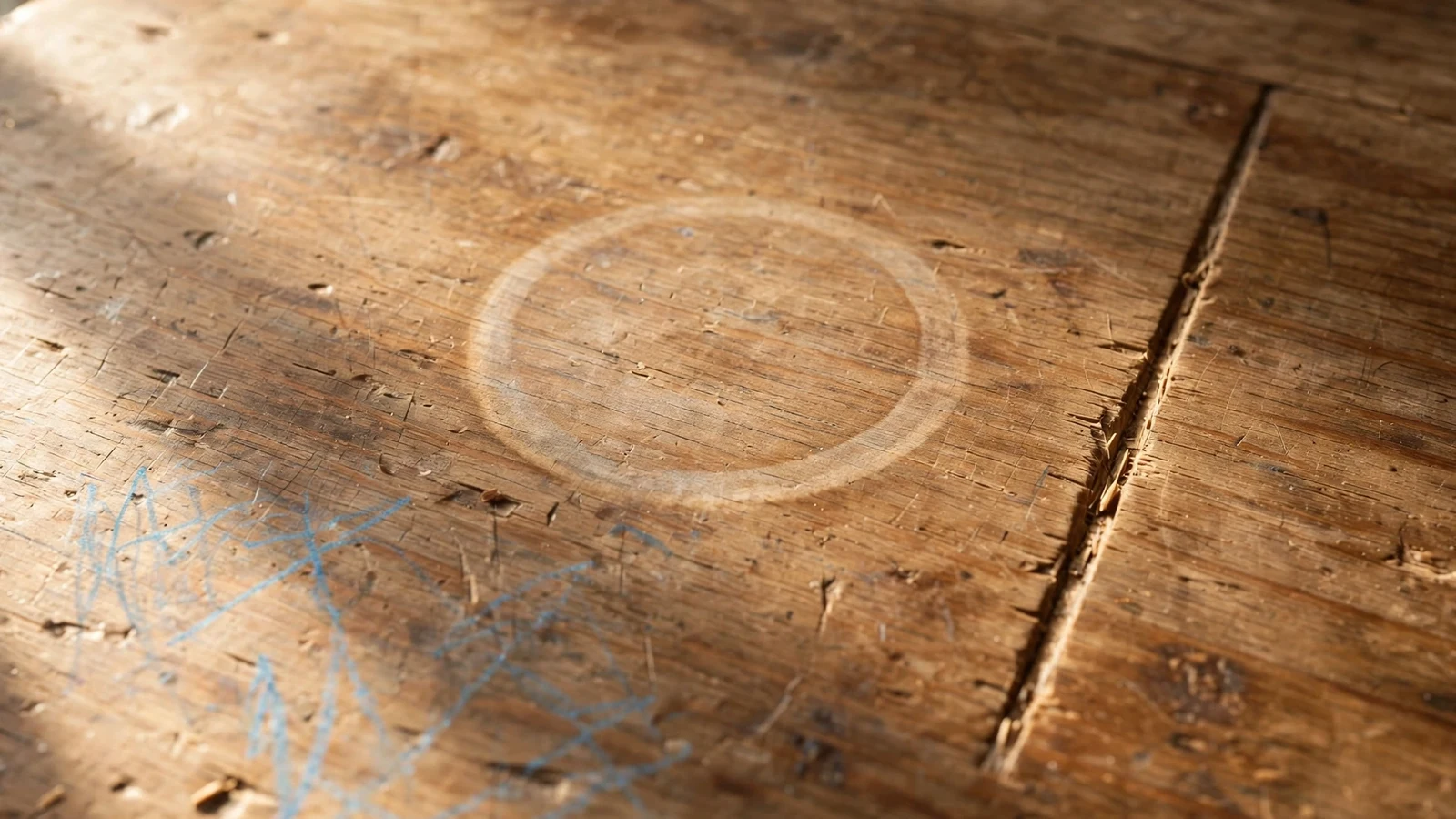
A table like ours does not arrive all at once. It arrives in layers, one meal at a time, and you only notice how much it has changed when you look at it the way a stranger would. A friend came over for coffee last winter and set her cup down and then lifted it and said, “Oh, sorry, is that ring new?” It was not new. It was three years old. But hearing someone else notice it made me see the table with fresh eyes, and what I saw was a surface that had given up trying to look cared for.
That was the real reason we refinished it, even if neither of us said so at the time. It was not about the scratches. It was about the feeling that we had stopped taking care of a thing we used every single day, and that the not-taking-care had become a habit. The table was where we ate breakfast, where we paid bills, where we talked through hard weeks. It deserved better than our neglect, and we both knew it.
We talked about buying a new table first, because that is the easy answer. We looked at prices online for one evening and closed the laptop without buying anything. A new table would have cost eight hundred dollars at the low end, and it would have been a stranger in our kitchen. The old table knew our house. It knew where the light fell in the morning and which leg wobbled on the uneven tile. We decided to keep it, and to do the work ourselves.
The year we fixed the house together taught us the same lesson on a bigger scale. The year we fixed the house together started with a leaking window and ended with us learning that a house you repair together feels more like yours than a house you buy perfect. The table was the same idea, shrunk down to one piece of wood.
The sanding weekend

We started on a Saturday morning, which was our first mistake. A sanding project that starts on a Saturday morning has to end by Sunday night, or the kitchen stays unusable into the work week, and that deadline shaped everything that followed. We moved the table out to the garage, spread a drop cloth on the concrete, and stood there looking at it like two people who had agreed to something neither of them fully understood.
The sanding itself was simple and miserable in equal measure. The orbital sander we borrowed from a neighbor was heavier than it looked, and the dust got everywhere, into our hair, into our shirts, into the garage corners we had not cleaned in years. We wore masks that fogged our glasses, and we kept stopping to argue about the grit. He wanted to start coarse and move fast. I wanted to start medium and go slow so we did not gouge the wood. We were both right, in our own way, and both wrong, in the same way, which is how most of our arguments go.
“Let me do the edges,” I said, after he had taken two passes too many over the same spot near the burn mark. “You are digging a valley into it.” He handed me the sander without a word, which was his way of saying he knew I was right and did not want to say so out loud. I took it, and then I dug my own valley into the opposite edge, and we both laughed, because there is nothing like making the exact mistake you just corrected someone for to take the heat out of a fight.
By Saturday night, the table was down to bare wood, pale and plain and a little smaller than we remembered. It looked naked. We ate takeout standing up in the kitchen, because there was nowhere to sit, and we talked about the stain color while the smell of sawdust hung in the air. He wanted a dark walnut. I wanted a light honey. We went back and forth for twenty minutes, and then he said, “What about the one in the middle?” We found a medium oak on the shelf at the hardware store the next morning, and it was the right answer, and neither of us had thought of it first. That happens a lot in our marriage. The answer neither of us brought to the table turns out to be the one we both like.
We stained it on Sunday, two coats, with a rag and a brush and a lot of patience. The wood drank the first coat unevenly, darker in some spots, lighter in others, and I panicked a little. He told me to wait for the second coat, and he was right. The second coat evened it out, and by Sunday evening the table looked like a table again, only warmer, and more like something we had chosen on purpose.
The finish that did not come out perfect
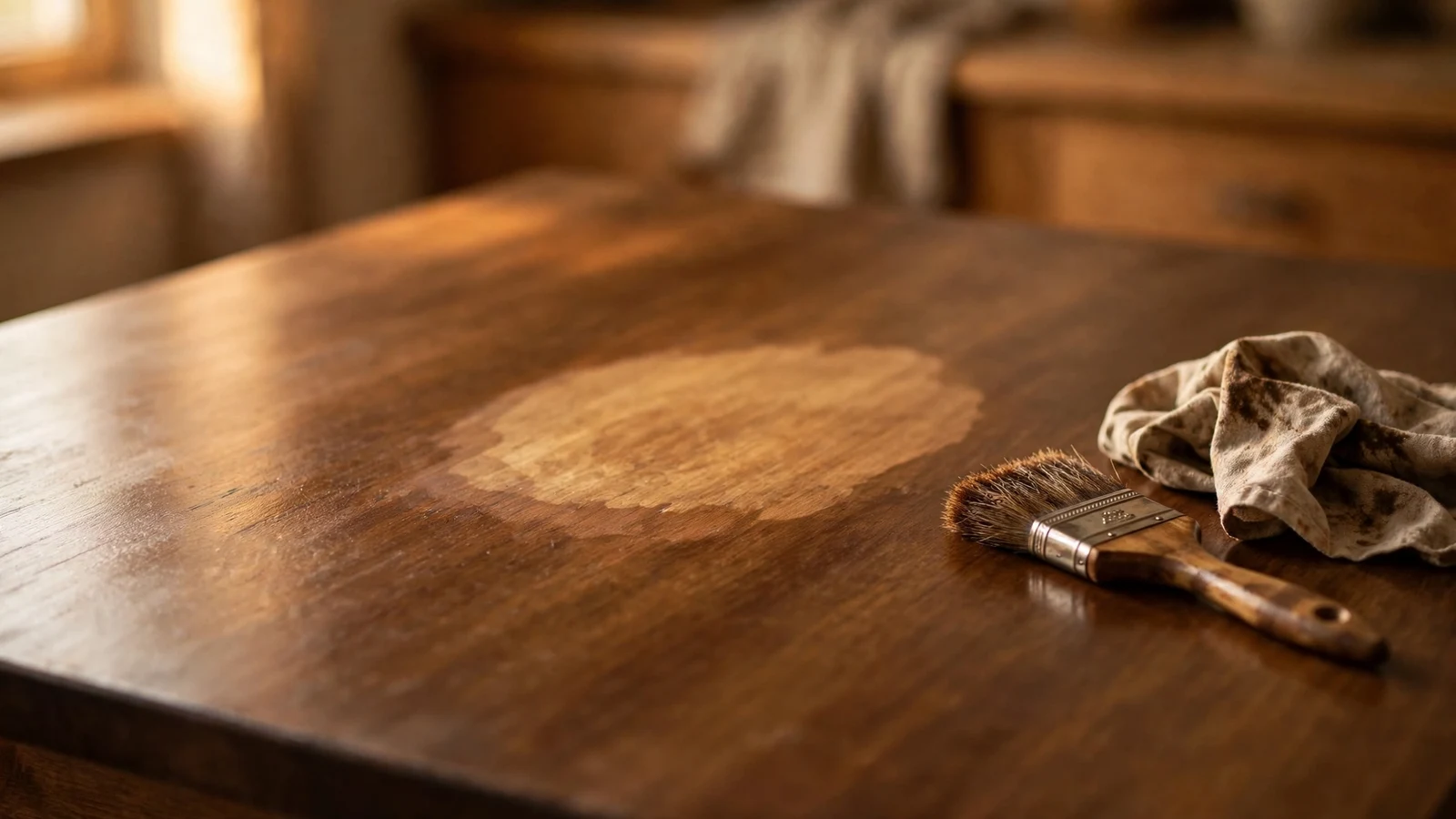
The finish did not come out perfect. I should say that plainly, because anyone who has ever refinished a table will nod, and anyone who has not should know it before they start. There is a drip on the underside of the edge, where the polyurethane pooled and dried into a small ridge you can feel if you run your finger along it. There is one patch near the center, right where the burn mark used to be, that dried a shade lighter than the rest, as if the wood there remembered the heat and refused to take the stain the same way. And there is a faint swirl in one corner where the sander caught an edge and left a mark that no amount of fine-grit paper could fully erase.
We saw all three flaws the moment we carried the table back into the kitchen, and we stood there in silence for a beat, the way you do when you have worked hard on something and it is not quite what you pictured. Then my husband ran his hand over the lighter patch and said, “That is where the skillet was.” And I said, “I know.” And that was the end of the disappointment, because the flaw was not a flaw anymore. It was the table’s history, showing through the new finish, the way it should.
A new table would have been perfect and empty. Our table is imperfect and full. The drip on the edge is there because we did it ourselves, with a brush, on a Sunday, in a garage full of dust. The lighter patch is there because ten years of dinners happened on that wood before we ever thought to sand it. Perfection would have erased all of that. The imperfect finish kept it.
We have a shared bookshelf in the living room with the same philosophy behind it. One shelf, both of us choosing, and the books do not sit straight and the mix looks odd until you live with it for a while. Then it starts to look like us. The table is the same. It looks like us now, in a way it did not before we sanded it, because the work of fixing it is part of what it holds.
What the table holds now

The table holds the same things it held before, and that is the point. It holds breakfast, two mugs, the newspaper folded into quarters, and the quiet ten minutes before the day starts. It holds the bills on Sunday night, spread out in a fan, and the short conversation about what we can spend this week and what has to wait. It holds the laptop when one of us works from the kitchen, and the cutting board when the other one cooks, and the space between them where we pass things back and forth without thinking about it.
It also holds the things that are harder to name. It holds the morning after a fight, when one of us puts the coffee down in front of the other without a word, and the other one says thank you, and that is the whole apology. It holds the evenings when we sit across from each other with a quiet evening ritual and talk about the day instead of staring at our phones. It holds the plans we make in pencil, the ones we change, and the ones we keep. A table that gets this kind of care is one of the quiet signs your marriage is stronger than you realize, even on the weeks when nothing feels special.
What changed is not what the table holds. What changed is how we look at it. We notice it now. We wipe it down after dinner instead of leaving the crumbs for morning. We use coasters, mostly. We set the hot pan on a trivet, every time, without having to remind each other. Taking care of it turned out to be easy once we had done the hard work of fixing it, and the hard work turned out to be the part that mattered. The sanding was not really about the wood. It was about choosing, together, to take care of something we share.
If your table is scarred, and your kitchen has a piece of furniture you have stopped seeing, try this. Pick one weekend. Borrow a sander. Argue about the grit. Laugh when you make the same mistake twice. Let the finish come out a little imperfect, and keep it anyway. The table you fix together will hold more than the table you buy, because every time you sit down at it, you will remember the weekend you chose it again.
Tell me, what is the most worn-out thing in your house, and what story does its oldest scratch tell?
Exact words to say
A project like this needs a few sentences, because a shared project can turn into a power struggle fast, and the right words at the start keep it a joint effort.
To propose it, try this. “What if we spent one weekend fixing the table instead of buying a new one? I think it would look good, and it would cost a lot less.” That sentence makes it a question, not a plan already decided, and it gives a practical reason alongside the hopeful one.
When you disagree about a detail, say so plainly and early. “I want the lighter stain, and I know you want the darker one. Can we look at the one in the middle before we decide?” That sentence names both positions, and it offers a third option instead of a winner and a loser.
When one of you makes a mistake, and you will, keep it small. “That spot is a little deep, but we can sand it out. Hand me the sander and I will show you.” That sentence names the problem, names the fix, and does not turn a sanding mark into a character judgment.
When the finish comes out imperfect, say what is true. “It is not perfect, and I like it anyway, because we did it.” That sentence closes the project with honesty and pride, and it leaves no room for either of you to keep score about whose idea the stain color was.
Sitting down to a meal at a table you fixed together tastes different, and a shared dinner at home is the simplest way to enjoy it. Cook something easy, light a candle if you like, and eat at the table you sanded. That is the whole celebration.
Frequently asked questions
How long does it take a couple to refinish a kitchen table?
Plan for one full weekend. Sanding takes most of a Saturday, staining takes a few hours on Sunday, and the finish needs a full day to cure before you put anything hot on it. Rushing any of those steps is how drips and uneven patches happen, so give each one the time it asks for.
What if my spouse and I disagree on the stain color?
Pick three samples, put them on a hidden corner of the table, and live with them for a day before you decide. A color looks different in morning light than it does under the kitchen lamp at night, and seeing it in both lights ends more arguments than debating it in the store. If you still disagree, try the shade between your two choices. It is often the one you both like.
Is it worth refinishing a table instead of buying a new one?
If the table is solid wood and the frame is sound, yes. A refinish costs a fraction of a new table, and you keep a piece of furniture that already fits your kitchen and your life. If the legs wobble, the joints are loose, or the wood is veneer thin enough to sand through, a new table is the kinder choice.
Keep Reading
If this hit home, these might too:
- The Year We Fixed the House Together
- How Couples Share One Bookshelf
- Evening Ritual for Couples
- Couples Eat Dinner Together
Going through something similar?
Share your experience anonymously with the Ever After Daily community. Every story is read by a human editor before anything is published.
Share Your Story