
8 Small Signs a Blended Family Is Actually Starting to Gel
Blended family signs its working often look quiet, not dramatic. Eight small, real moments that mean your family is actually starting to gel together now.
8 Small Signs a Blended Family Is Actually Starting to Gel
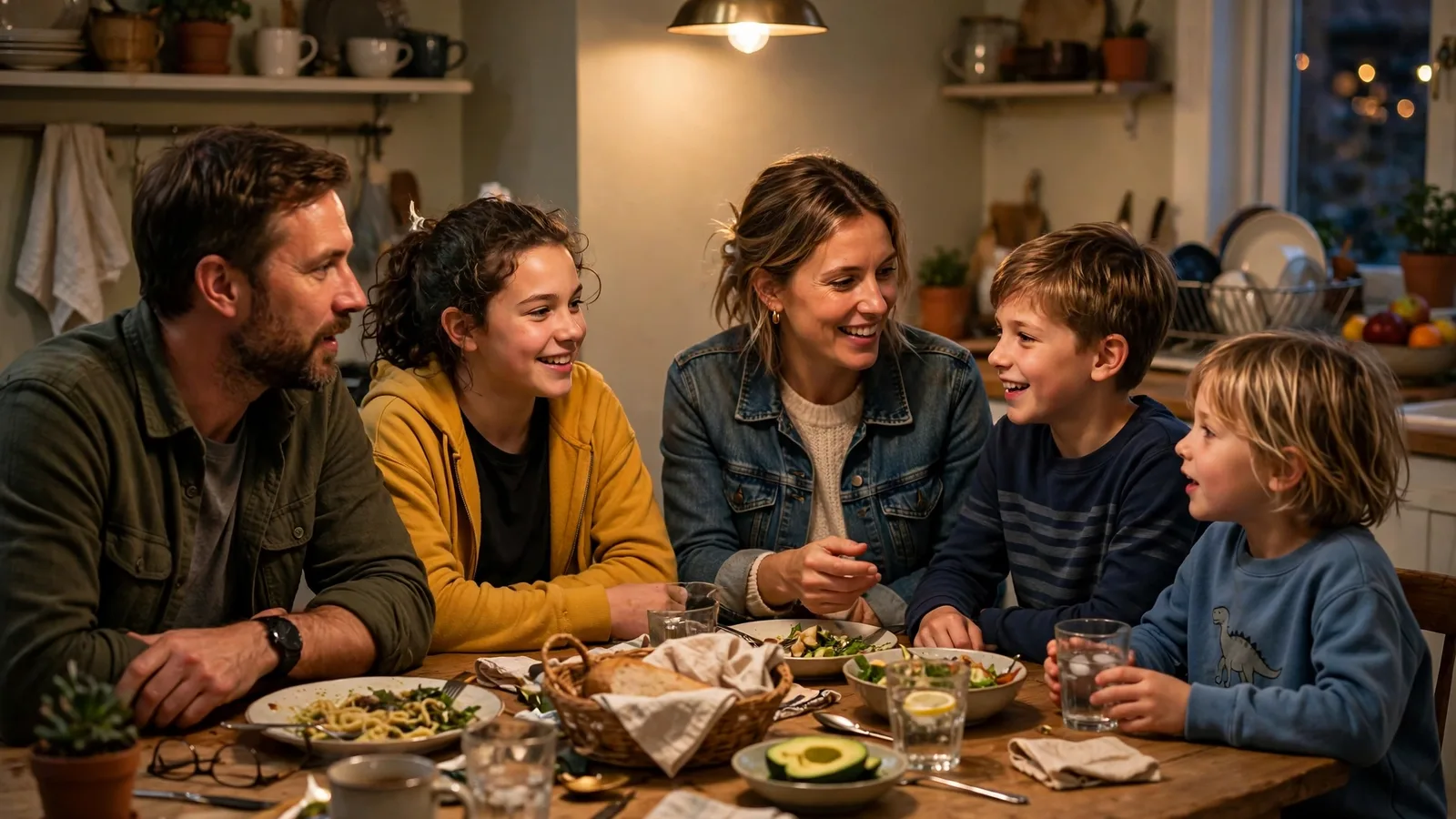
Blended families don’t usually get a big, cinematic “we did it” moment. There’s no afternoon when the kids line up on the porch in matching sweaters and agree, as a group, that things are officially good now. What you get instead is Tuesday. Ordinary, slightly chaotic Tuesday. And somewhere inside Tuesday, something small happens that’s different from how it would’ve gone six months ago, and you think — huh. That was new.
That’s what progress looks like here. It’s quiet. It’s almost suspiciously quiet, because the hard middle of blending a family trains you to scan for what’s still broken. You notice every closed door, every eyes-on-phone dinner, every “you’re not my mom” that lands like a small hammer. It’s fair to stop, at least on purpose, and learn to notice what’s quietly working. Because in most blended families that do eventually feel like real families, the turn wasn’t loud. It was these eight small things, arriving out of order, some of them more than once.
If you’re still earlier in the story — somewhere closer to dating again after divorce, or figuring out the timing in introducing new partner to kids — this list can serve as a map of where “eventually” tends to lead. And if you’re in it now, read it as a checklist of hope, not a report card. Families gel at wildly different speeds. Kids gel at wildly different speeds from each other, in the same house, on the same couch.
Boredom Shows Up Instead of Performance

Early on, everything in a blended house feels like an audition. The stepkids are either extra polite or extra provocative. Your own kids watch themselves being good in a slightly strained way. Everyone’s aware of being seen being okay with this. That low hum of performance is exhausting, and weirdly, its disappearance is one of the first real signs.
The sign looks like this: your stepson wanders into the kitchen in socks, opens the fridge, closes it, opens it again, sighs like a weary office worker, and asks what’s for dinner in the exact tone he’d use with his own people. He isn’t charming you. He isn’t testing you. He’s bored, and he’s assuming food will appear. Boredom is a form of trust. Kids save their most unguarded, least impressive selves for people they consider safe. When a stepkid starts being ordinary around you — a little mopey, a little careless, sprawled on the floor in the walking path — the performance has ended. That’s not rude. That’s home.
Conflict Gets Small and Specific
In a family that isn’t gelling, conflict is global. A dispute about shoes becomes you always, this house never, nobody here cares about. The argument is never really about shoes. It’s about belonging, fairness, loyalty — all the big unnamed weather underneath.
When things start working, the arguments shrink. A real fight in a gelling house sounds like: “You moved my charger.” “It was on the counter.” “I charge it THERE. That’s my spot.” “Fine. Sorry.” — and then, an hour later, the same two people are arguing about something genuinely small, like whether the dog gets a say in movie night. Small, specific, ending arguments are a sign the big questions have quieted down enough that people can afford to bicker about the surface. Siblings have fought this way forever. Steps starting to fight this way — and recover this way — means the nervous system of the house is changing.
What helps it change is repair. Even clumsy repair. The family rebuilding after a rupture learns a lot from the plain mechanics in how to apologize after a fight — short, specific, no courtroom summary. In a blended house, the sentence that matters most usually sounds like: “I was short with you at breakfast. That wasn’t fair. My bad.” No speech. Just a clean repair, offered early, teaching everyone that conflict here doesn’t end marriages, homes, or belonging.
The “You’re Not My Mom” Moments Get Rarer — and Softer

Let’s be honest: this sentence is the blended-family rite of passage nobody orders. It almost always arrives not because you’re terrible, but because the kid’s loyalty alarm went off. Liking you started to feel like betraying their other parent, so the sentence flies out as a kind of reset button.
The gel sign isn’t that it vanishes forever. It’s that it changes character. It comes less often. It loses its grenade quality and lands more like a door huffed shut than a wall slammed. And sometimes — this is the part stepparents describe with tears in their eyes at entirely inappropriate moments, like in the grocery store — it gets replaced, not by “Mom,” but by something earned and specific. Your name called from the other room when something good happened and you’re the one they want to tell. A hand-drawn card where you’re placed in the lineup, slightly off to the side, but in the lineup. The kids don’t retire the fact of two homes and two histories. They just stop needing to defend it against you quite so often.
Stepparents often speed this up by doing less, not more — the unglamorous patience you can read about in stepparent bonding tips and in what stepkids need, where the headline is usually: availability without pressure. Love offered on a standing invitation, not a schedule.
Inside Jokes Start Belonging to Everyone

Every family has its mythology — the burned pancakes story, the vacation where the car died in the rain, the phrase somebody said once that now ends every dinner. Blended families start with two separate mythologies and a lot of courteous silence when the other family’s stories get told. You’re smiling at the table, but you’re a guest at someone else’s memory.
You’ll know something has shifted the first time a joke gets born that belongs to the new unit — the grace-before-dinner one-liner about the stepdad’s garlic bread, the nickname for the cat that only makes sense in this house, the impressions of the world’s squeakiest bathroom door. When your kid starts telling the new family’s story to a friend — “okay, so, at our house, Matt always—” — and you hear yourself described as part of the cast rather than an emcee, the mythology has merged. Nobody voted on it. Humor is the least forced form of belonging there is, and it can’t be scheduled. It can only be noticed, and protected, and told again next week.
Kids Stop Reporting and Start Living
In the tender early seasons, kids often function as tiny diplomatic couriers between houses. They carry messages — “Mom says the dentist money goes through the app” — and they carry intelligence, too. What got said. What the new partner is like. Whether anyone seemed mad. This reporting is normal. It’s a loyalty behavior: the child proving, to both sides, that they haven’t switched teams.
The gel sign is when the courier goes quiet because there’s nothing urgent to carry. Your daughter comes back from the weekend and, asked how it went, says “fine, they have a cat now, can I have a snack?” in one breath. Not a briefing. A snack request. The information economy between houses has calmed because the child no longer feels responsible for keeping both worlds informed and safe. That’s also usually when co-parenting with a difficult ex gets a fraction easier — less material passing through small hands means fewer sparks.
The adult job here is to not rehire the courier. Keep the direct channels direct: calendars, apps, grown-up-to-grown-up messages. When a kid does deliver a loaded message, the kindest response is short: “Thanks for telling me. That’s grown-up stuff — I’ll talk to Dad about it directly. You don’t have to hold that.” Say it enough times, kindly, and they believe you, and they put the job down.
Repair Speeds Up — Even When Nobody’s Great at It Yet
No family, blended or otherwise, wins at harmony. The ones that work win at repair. Late last year, in plenty of healthy two-parent-since-forever families, a slammed door still means somebody’s having a slammed-door evening. The metric that predicts a family’s future isn’t whether the door slams. It’s whether, on the same evening, somebody knocks.
So watch your repair latency. Six months ago, a bad dinner meant two days of frost — your partner distant, a stepkid monosyllabic until Thursday. Lately, you’ve noticed the thaw coming faster: somebody makes tea for a person they’re still slightly annoyed with; a text goes out — sorry, long day, wasn’t you — before bed instead of after a weekend. Even your own repair between partners matters here. Kids watch the adults fight-fair-and-fix-it in real time, and the couples who’ve done harder repair work — the kind explored in can marriage survive infidelity or marriage counseling vs couples therapy — will tell you the visible, boring, repeated fix is what eventually teaches a house that storms pass.
The exact words matter less than the turnaround. But if you want a script for a stepkid-sized repair, this one is gentle and works: “Earlier I snapped about the shoes. I’m sorry. I care about the mud situation, but I didn’t need to make it a whole speech. We’re good.” Then actually be good. Don’t re-litigate the shoes at dinner.
Your Partner Picks You in Small, Un-dramatic Ways
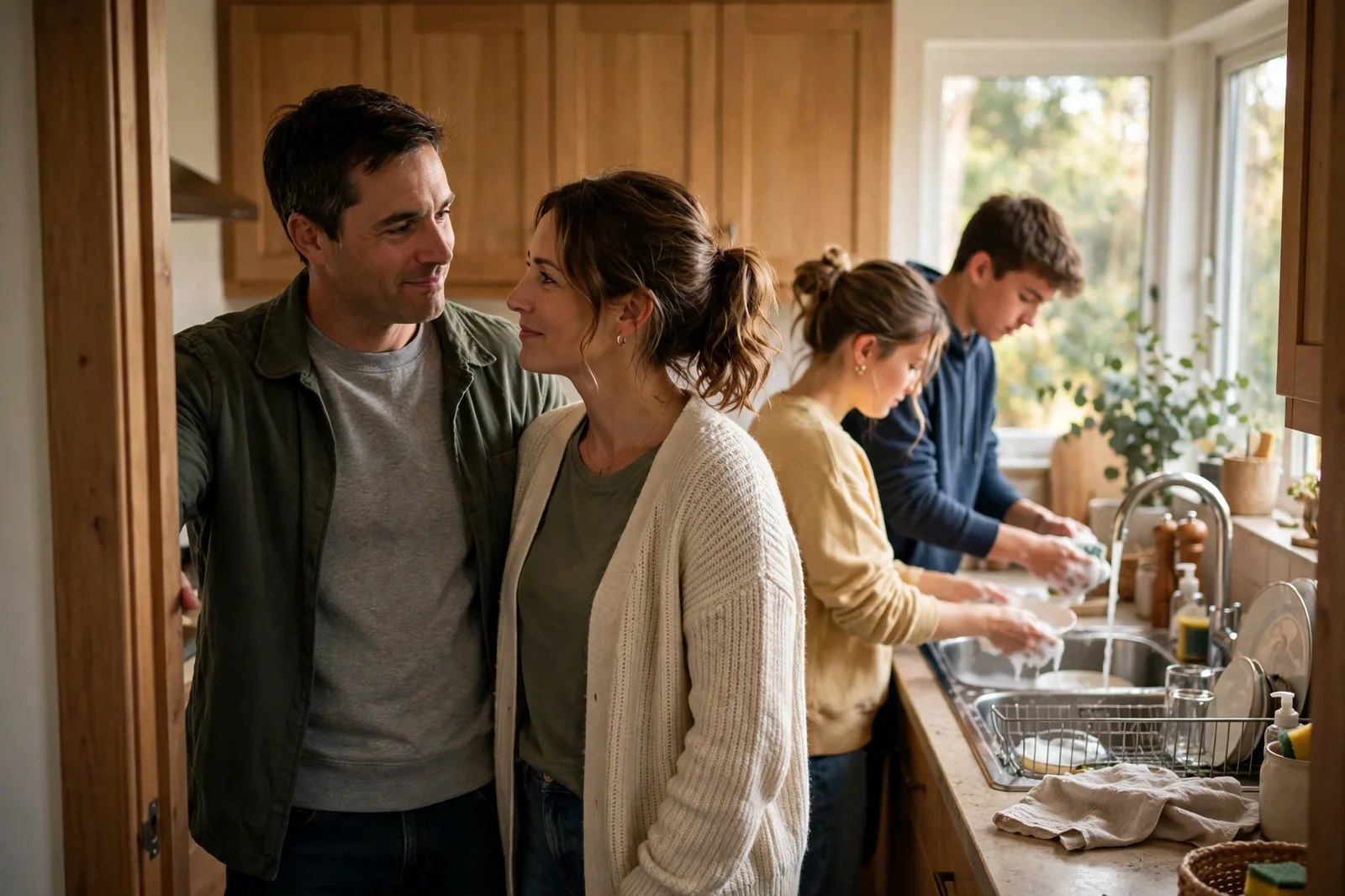
A blended family gels from the adults’ alliance outward. The kids read that alliance constantly — through walls, through tone, through who backs whom at 6:45 on a school morning. In the hard middle, you’ll feel the opposite: your partner bending so far toward their child’s comfort that you end up the household’s adjustable wrench, absorbing every compromise.
The sign it’s turning is small alliance moments that nobody announces. Your partner hears their teenager aim a crack at your cooking and says, mildly, “Hey. We don’t do that here. You can skip the casserole; you can’t narrate it,” and then the evening just… continues. No summit. No tears. That’s what a unified front actually looks like in the wild: unglamorous, brief, done. And the reverse sign is just as real — you, defending your stepkid’s privacy to your own curious relative on the phone. “She’s not a report, Aunt Linda. She’s having an okay week.” The kids will never thank you in the moment. They’ll log it, though. Kids log everything.
Couples who came into a second marriage after doing the honest talking listed in second marriage advice usually describe this as the payoff chapter: the teamwork they planned in theory starts showing up as reflexes at breakfast.
Weekends Stop Feeling Like Hostage Negotiations
Early blended life runs on logistics dread. Whose weekend. Who drives. Which kid needs to be at which field with which cleats. The two-household calendar can feel like a part-time job in air traffic control, and free time — actual unscheduled, in-pajamas, nobody’s performing time — is the first casualty.
So the last sign is a scheduling miracle of the ordinary kind: a Saturday that just… happens. Pancakes get made by whoever woke first. One kid teaches another kid a card game that their other house doesn’t play. Somebody proposes a movie in the afternoon and nobody treats it like a referendum on the family’s legitimacy. The house has developed a default setting, and the default is no longer vigilance. You realize, standing at the stove, that you aren’t monitoring the room. You’re just in it.
That ordinariness is the whole prize. It’s what everyone was actually signing up for — not a blended-family brochure, just a life.
Frequently Asked Questions
How long does it take for a blended family to feel normal?
There’s no timeline anyone can honestly hand you, and you should be suspicious of articles that do. What most blended families describe is gradual: the first year is usually about logistics and politeness, the following years are when trust, jokes, and habits deepen — and it keeps evolving as kids age, move between houses, and hit new stages. Progress is rarely linear. Two calm months can be followed by a rough patch around a holiday or a loyalty wobble at the other house, and that’s weather, not a verdict. Measure in seasons, not weekends.
My stepkids are warm one week and distant the next. Is that a bad sign?
Usually not — it’s often the exact pattern of a kid processing loyalty at a pace they can handle. Closeness to you can spike a feeling of betrayal toward their other parent, and a little distance is how many kids self-correct to a level that feels safe. The steady response is to stay warm and available without pursuing. Let them set the dosage. Distance that slowly trends toward ease over months is very different from distance that’s part of a sudden change, withdrawal, or visible distress — in that case, a check-in with their parent and, if needed, a family therapist is a good move.
What if one child is gelling and the other isn’t?
Then you have a normal blended family. Siblings almost never sync up: age, temperament, loyalty binds, and how much change the merger cost them all differ kid to kid. The trap is treating the warmer child as proof and the slower child as the problem. Keep expectations, warmth, and repair the same for everyone, and let each kid arrive on their own clock. The slower kid is often watching how you treat them while they’re slow — and that’s the audition that actually matters.
Let’s Talk About It
If any of these signs felt familiar, we’d love to hear which one showed up first in your house. Sometimes it’s the fridge-staring stepson. Sometimes it’s a joke that only makes sense in your kitchen. Sometimes it’s a Saturday so ordinary you didn’t even notice it until later — and that, honestly, may be the best sign of all.
Tell us in the comments: what’s the smallest moment that made you think, oh. we might actually be a family?
Keep Reading
If this hit home, these might too:
- dating again after divorce
- introducing new partner to kids
- how to apologize after a fight
- stepparent bonding tips
- what stepkids need
- co-parenting with a difficult ex
- can marriage survive infidelity
- marriage counseling vs couples therapy
- second marriage advice
Going through something similar?
Share your experience anonymously with the Ever After Daily community. Every story is read by a human editor before anything is published.
Share Your Story


