Couples Who Learn Something New Together After 60
Past sixty, one shared class can give a marriage a new project. How couples pick a class, survive being beginners, and finally learn something real together.
Couples Who Learn Something New Together After 60
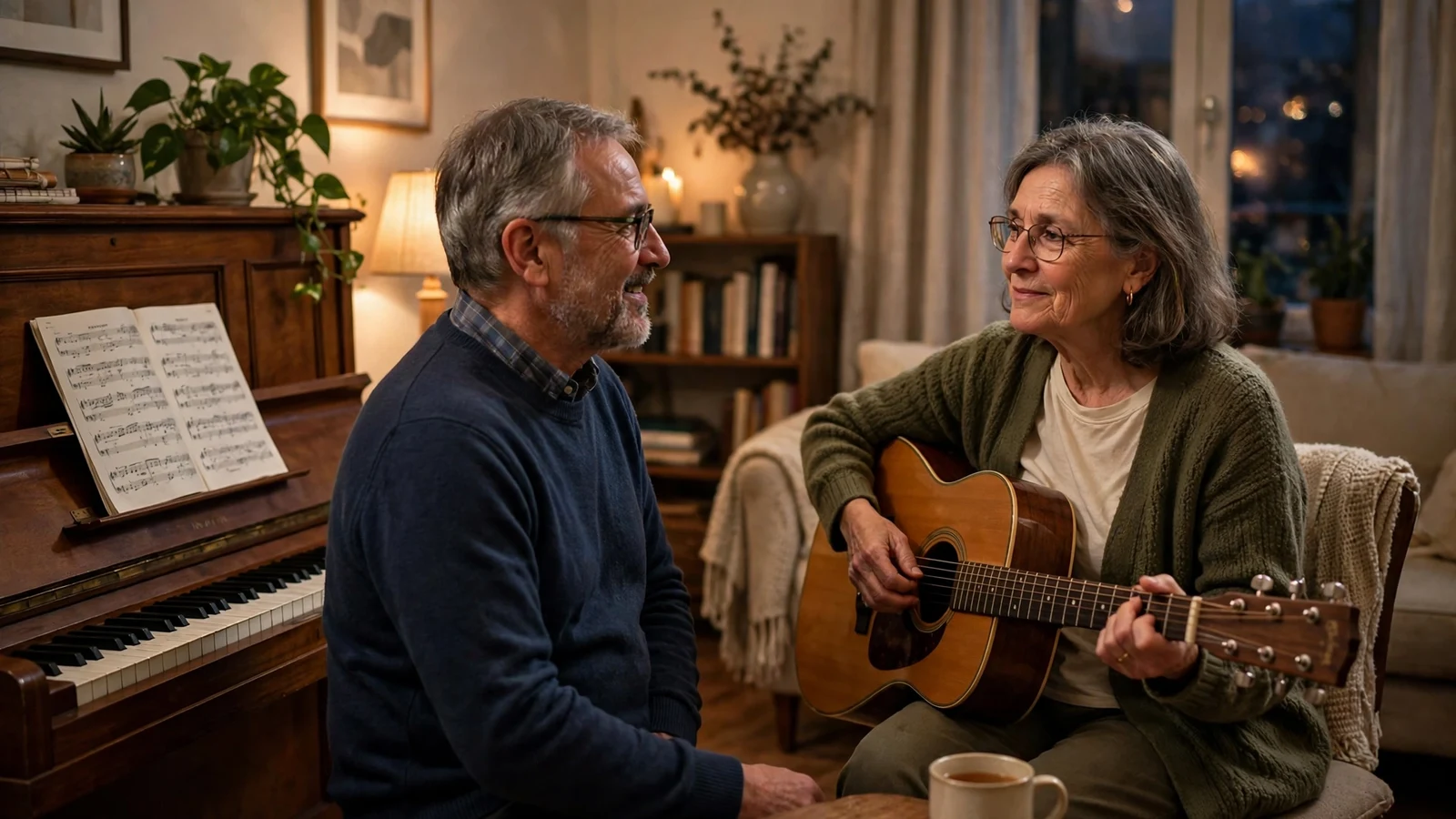
The first time we played a song all the way through, we were sitting in our living room on a Tuesday night, and the dog was asleep on the rug, and the guitar was in my lap, and his hands were on the piano keys, and the song was a simple one, four chords, the kind a child learns in the first month. We had been taking lessons for six weeks. We had sounded terrible for five of them. But that night, the four chords lined up, and the melody came out the other side, and we looked at each other across the living room, and then the song ended, and he said, “Again.” We played it again. That was the night we learned that sixty is not too late to be bad at something together, and that being bad at something together is one of the best things a marriage can do.
We signed up for the class because the house was quiet and the evenings were long and we had run out of things to talk about that were not the house, the kids, or the news. We needed a project, something with a teacher and a homework assignment and a reason to sit down together on a Tuesday night. The community center had a list: pottery, Spanish, guitar, watercolor, woodworking, photography. We picked music because it was the one neither of us knew anything about, and that turned out to be the whole point. When both of you are beginners, nobody is the expert, and nobody is waiting for the other one to catch up. You start at the same place, on the same day, and you learn at the same speed, which is slow, and that is fine, because slow is how learning works when you are past sixty and in no hurry.
Picking it: short, cheap, both beginners

The picking matters more than people think. A class you pick wrong will not last a month, and a class you pick right will carry you through a whole year. The rules we use are simple, and they have held up for every class we have tried since: short, cheap, and both of you beginners.
Short means a class that runs six or eight weeks, not a year. Six weeks is long enough to learn something real and short enough that you can see the end from the first night. If the class is a bad fit, you only have five more weeks, and you can say so honestly at dinner without feeling trapped. If the class is a good fit, six weeks is long enough to know it, and you sign up for the next one. A year-long commitment is a promise you make before you know what you are promising. A short class is a try, and a try is all you need to start.
Cheap means a class you can pay for without a conversation about the budget. The community center, the library, the senior center, the night class at the high school. Forty dollars, sixty dollars, maybe a hundred for the term, plus the cost of the thing itself, a guitar, a set of paints, a camera you already own. Cheap matters because it keeps the stakes low. When a class costs a lot, every lesson feels like a test, and a test is the opposite of what you want. You want a room where it is fine to be bad, and a low price is what makes the room feel that way.
Both beginners is the rule that matters most. Pick something neither of you has done before. Not the thing he did in high school. Not the thing she took a class in twenty years ago. Something new to both of you, on the same day, from the same starting line. When one person already knows the thing, the class turns into a lesson for one and a waiting room for the other, and the waiting room is where resentment grows. When both of you are beginners, you struggle at the same speed, you laugh at the same mistakes, and you help each other with the same homework. That shared struggle is the point. It is what the class is for, even more than the skill itself.
Try one thing each, the way you would try a cause or a restaurant. He picks one, you pick one, you try both, and you keep the one that fits. A hobby you pick up together is often how couples find the class that sticks, because the things you enjoy doing point to the things you will enjoy learning. We tried Spanish before we tried music. He picked Spanish because he wanted to order food on a trip we were planning. I went, and I was terrible at it, and he was worse, and we laughed all the way home, and we did not go back, because the laughing was the best part and the Spanish was not. Music was my pick, and music stuck. The trying is not wasted time. The trying is how you find the thing, and the thing you find is usually the third one you try, the one neither of you expected.
The class: the teacher, the other students, the homework
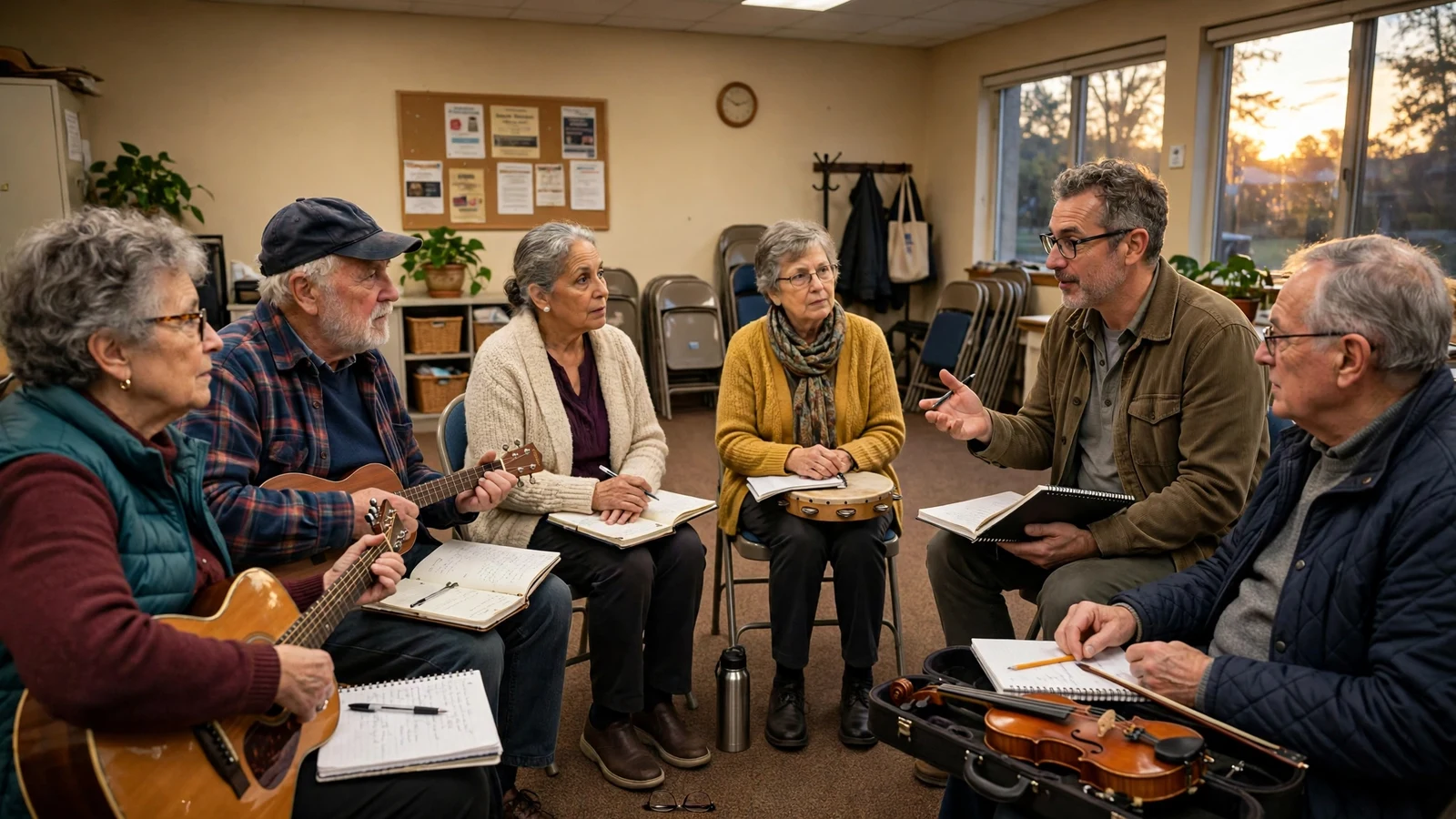
The class itself is a small world, and it has its own rhythms. Ours meets on Tuesday nights, seven to eight-thirty, in a room at the community center with bad lighting and good chairs and a piano that is older than both of us. The teacher is a woman named Rosa, who is sixty-eight, who played in a band when she was young, and who has the patience of a person who has taught a hundred beginners and knows exactly where each one will get stuck. She does not rush us. She does not pretend we are talented. She tells us what to practice, she listens, she nods, and she says, “Again.” Rosa is the reason the class works. A good teacher for older beginners is not the one who knows the most. It is the one who knows how to let you be slow without making you feel slow.
The other students are part of it too. There are eight of us, most of us past sixty, most of us in couples, most of us there for the same reason: the house is quiet, the evenings are long, and we wanted a reason to leave it together. There is a couple who are learning together because their daughter gave them a guitar for Christmas. There is a woman who comes alone because her husband stays home and does the crossword, and she tells us about him every week. The room has a warmth to it that has nothing to do with the heating. It is the warmth of people who are all bad at the same thing, in the same room, at the same time, and who are glad about it.
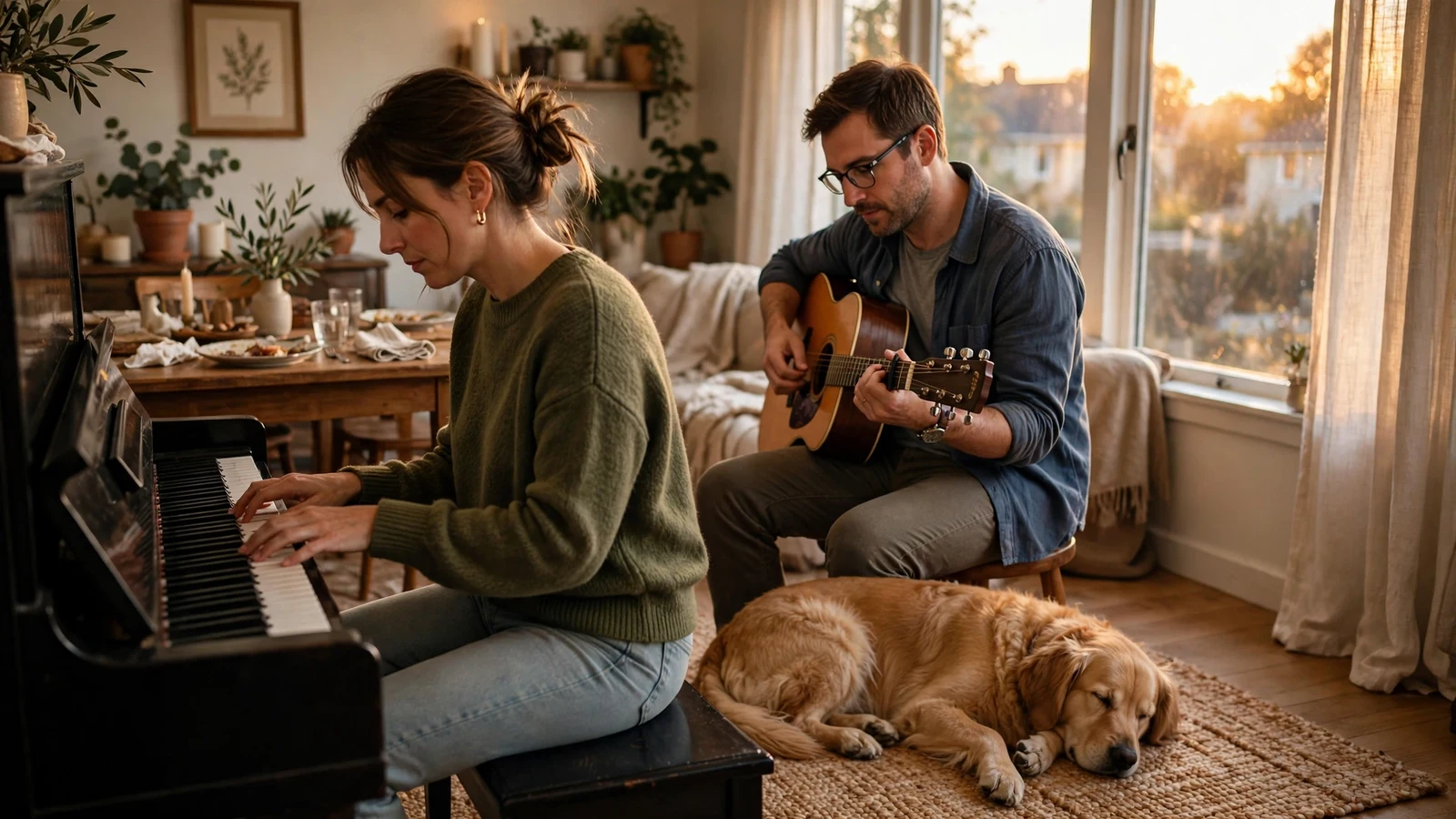
The homework is the part that surprised us most. We did not expect to have homework at sixty-five, and we did not expect to like it, but we do. Rosa gives us one small thing to practice each week, one chord, one scale, one page of a song, and we practice it together after dinner, in the living room, with the dog asleep on the rug. He plays the piano part. I play the guitar part. We stop, we start again, we argue gently about the tempo, we laugh, we try again. The homework gives the evenings a shape they did not have before. Instead of two people in two chairs watching the same television, we are two people in one room working on one thing, and the room feels different because of it.
There will be a week when one of you wants to quit. It usually comes around week four, when the newness has worn off and the hard part has arrived, when the chords do not come any faster and the homework feels like work. A weekly check-in at home is the right place for that talk, not the car on the way to class. Ask what part is hard, the skill or the schedule or the room. Often the fix is small: a different practice time, a different chair, a different song. If the class is truly wrong, you will know it, and you can finish the six weeks and pick the next thing. But most of the time, the wanting to quit is just the middle of learning, and the middle is where the learning happens. Get through week four together, and week five will surprise you.
The thing they can finally do
The thing you can finally do is smaller than you imagined, and it is better than you imagined, because it is real. You will not be good. You will not be impressive. You will be able to do one small thing, from start to finish, that you could not do before, and you will be able to do it together, and that is enough. That is more than enough. That is the whole point.
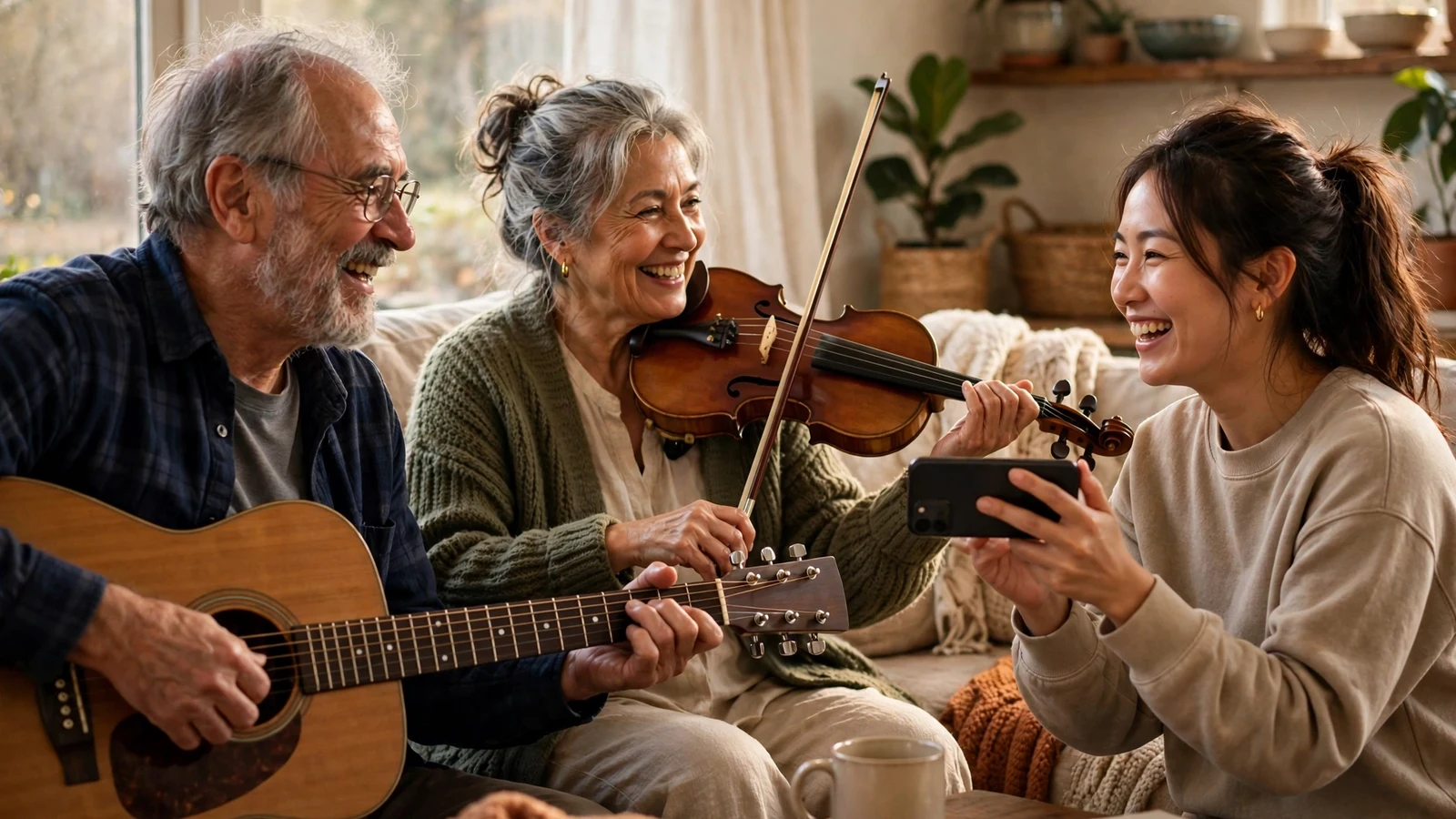
For us, the thing is a song. Four chords, a melody, a beginning and an end. We played it for our daughter when she visited, and she filmed it on her phone, and she sent it to her brother, and the two of them laughed, not at us, with us, the way kids laugh when their parents do something brave. We have played it at a birthday, at a dinner with friends, at a community center open house where Rosa asked us to play and we said yes before we had time to be nervous. Each time, the song is a little better, and each time, we look at each other at the end of it, and we know what we did. We learned a thing, together, past sixty, and the thing is ours.
Your thing might be different. A pot that holds water. A photograph that looks like the place you took it in. A sentence in Spanish that a waiter understands. A watercolor of the garden that looks, from across the room, like the garden. The size of the thing does not matter. The fact that you can do it, and that you learned it together, is what matters. A shared skill is a shared story, and a shared story is what a marriage runs on in the years after the kids leave, when the old stories have all been told and you need new ones.
Do not stop at one class. The first class teaches you how to learn together. The second class teaches you what you like. The third class is the one that becomes yours, the one you keep going back to, the one that gives your Tuesdays a shape for years. We are on our third class now, and we have a list for the fourth: photography, maybe, or woodworking, or the cooking class at the high school that smells like garlic every Thursday night. The list is long, and we are in no hurry, and that is the point. After sixty, you finally have the time to be a beginner, and being a beginner together is one of the best things a marriage can do.
Frequently asked questions
Is sixty too old to start learning something new with my spouse?
No. Sixty is a good age to start, because you have the time, the patience, and the freedom to be bad at something without it costing you anything. Pick a class where both of you are beginners, keep it short and cheap, and let the learning be slow. Slow is how it works at this age, and slow is fine.
What if my spouse is better at it than I am?
That happens, and it is not a problem unless you make it one. The faster one can help the slower one, and the helping becomes part of the class. If the gap grows too wide, pick a different thing, or a different class, where you start even. The point is learning together, not keeping score.
What kind of class should we pick first?
Pick something short, cheap, and new to both of you. A community center class that runs six to eight weeks is a good start. Try one each, keep the one that fits, and do not worry about being good. The class is for the two of you, not for an audience.
What would you and your spouse learn together, if you started this month? Tell us in the comments, if you are willing. Your answer might be the class another couple has been waiting to try.
Going through something similar?
Share your experience anonymously with the Ever After Daily community. Every story is read by a human editor before anything is published.
Share Your Story