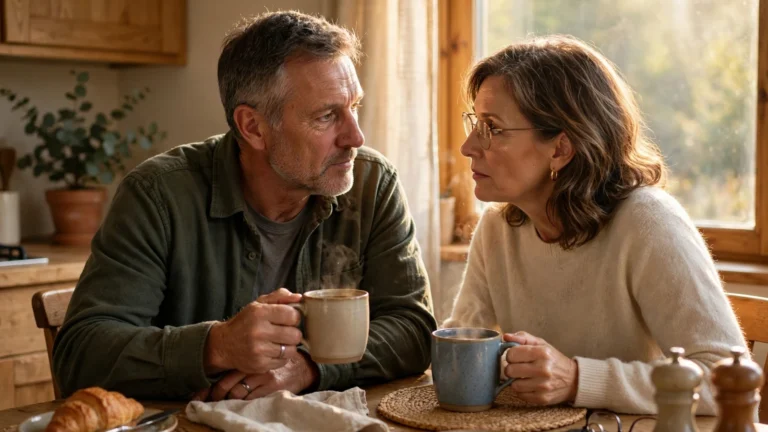
The Sunday Morning Rule Happy Couples Swear By
No plans before noon on Sundays: the morning belongs to us. One simple rule for the unhurried time together busy couples never get, five ways to do it.

The Sunday Morning Rule Happy Couples Swear By
Last Sunday I watched my husband butter toast at 10:40 in the morning, in his pajamas, while rain tapped the kitchen window, and I thought: this is the whole thing. Not the vacations. Not the anniversary dinners. This. Two people with nowhere to be.
We have a rule in our house, and it is the simplest thing we have ever done for our marriage: no plans before noon on Sundays. The morning belongs to us. Here is why it works, and how to make it yours.
The rule

No plans before noon on Sundays. That is it. No brunch invitations accepted before twelve. No errands. No “quick” trips to the store. The morning belongs to the two of you, and it is spent slowly, on purpose.
You can define noon however you like. Some couples draw the line at eleven. Some stretch it to one. The exact hour matters less than the shape of it: a protected window of unhurried time, every single week, that nobody else gets to book.
The first time you say no to something, it will feel strange. Someone will invite you to a 10 a.m. thing and you will say, “We can’t do mornings on Sundays,” and they will accept it the way people accept anything said with confidence. After the third week, it stops feeling like a rule and starts feeling like the way Sundays are.
Why unhurried time changes everything
Busy couples get a lot of time together. They get the ten minutes between the garage door and dinner. They get the car rides. They get the couch at 10 p.m. when both of them are half asleep and one of them is scrolling. What they almost never get is time together with no clock on it.
Unhurried time is the rarest currency in a marriage. Everything else, you can buy or schedule or fake. A date night can be rushed. A vacation can be packed with plans. But two hours with nothing on the agenda cannot be faked. It is the only setting where real conversation happens, the kind that starts with “remember when” and ends somewhere you did not plan to go.
This is also why the fancy date night was never the answer for a lot of couples. A reservation at eight does not fix a marriage that has no slow mornings. The Sunday rule works from the other direction: instead of adding one big romantic event to a rushed life, it removes the rush from one corner of the week.
You do not need more time together. You need some of your time together to be slow.
Five ways couples do it

There is no official Sunday morning activity. The rule is about the window, not the contents. Here are the five versions I hear about most.
The long breakfast
Pancakes, eggs, whatever takes a while. The cooking is part of it. One of you cooks, the other one sits at the counter and talks. Breakfast stretches to an hour without anyone noticing. This is the most popular version, and it works because food slows people down naturally.
The walk
Same route every week, or a different one. Coffee in travel mugs. The walk version is for couples who talk better side by side than face to face, which is more couples than admit it. Something about moving forward together loosens the conversation.
The paper-and-coffee
The actual newspaper, if you can still get one, or a magazine, or just two phones set to one long article. You read, you share the good parts out loud, you argue gently about the crossword. It is companionable silence with a shared object in the middle, and it counts.
The bed-lazy
No one gets up until someone gets hungry. You talk, you doze, you talk some more. This is the version with no production value at all, and some couples say it is the best one. There is something about a Sunday morning in bed that makes people say the true thing, the thing they would polish into a safer sentence at the dinner table.
The project
The garden bed. The bookshelf that needs building. The photo albums. One small shared project, worked on slowly, with coffee breaks. This version is for couples who bond through doing. The project gives your hands something to do while your mouths catch up.
Pick the one that fits, or rotate. The contents can change with the seasons. The window stays.
The honest caveat

Now the part where I am honest with you. Not every couple can do Sunday mornings.
If you have small kids, the window might be 6 a.m. to 8 a.m. before the house wakes up, and that counts. If one of you works shifts, pick a different morning and call it your Sunday. The day of the week is not the point. If church is your Sunday morning, then your protected window is Sunday afternoon, or Saturday morning, or whatever stretch of hours is actually yours.
Adapt the window. Keep the principle.
The principle is this: one recurring block of unhurried time, defended like it matters, because it does. Time alone together, without an agenda, is doing quiet work for your marriage even when it looks like nothing is happening. A couple protecting two slow hours a week is a couple that keeps choosing each other in the most ordinary way possible, which turns out to be the way that counts.
And if your marriage has been feeling flat lately, that flat feeling is usually a time problem before it is a love problem. Slow mornings will not fix everything. But they will tell you the truth about where you stand, because you cannot hide from each other for two unhurried hours.
The one-month test

Here is what I want you to do. Try it for one month. Four protected Sunday mornings, no plans before noon, and do not announce it like a marriage program. Just start.
At the end of the month, ask each other one question. Here are the exact words: “It has been a month of slow Sundays. What feels different to you?”
Then listen. Do not defend the rule. Do not sell it. Just listen to what your spouse noticed. Most couples hear something like: we laughed more. We talked about real things. I felt like we were us again. If you hear nothing, the rule cost you four mornings and you learned something. If you hear something, you keep going, and the rule stops being an experiment and starts being your life.
One month. Four mornings. That is the whole test.
Tell me how you would spend a slow Sunday
If Sunday mornings were yours, with no plans and no clock, what would you do with them? The long breakfast, the walk, the bed-lazy, or something I did not think of? Tell me in the comments. I read every one, and the best slow-Sunday ideas always come from couples who are already doing this.
Keep Reading
If this hit home, these might too:
- the fancy date night was never the answer
- time alone together, without an agenda
- that flat feeling is usually a time problem
- every close couple has a "thing"
- couples who stay happy over the long haul
- cheap ways to spend time together at home
Going through something similar?
Share your experience anonymously with the Ever After Daily community. Every story is read by a human editor before anything is published.
Share Your Story